油圧パワーユニットの選定方法:圧力、流量、モーター、ポンプの選定
Select a hydraulic power unit around actuator force, speed and duty cycle, then check pressure, flow, pump drive power, reservoir, controls and cooling.

A hydraulic power unit (HPU) is the energy source of a hydraulic system. Selecting the correct hydraulic power unit requires more than choosing a pump and motor. The complete unit must be matched according to the machine requirements, including pressure, flow, actuator size, duty cycle, installation space, and operating environment.
A properly selected hydraulic power unit can provide reliable performance, efficient operation, and long service life. An incorrectly selected unit may cause problems such as insufficient force, slow movement, overheating, excessive noise, unstable operation, or premature component failure.
The key factors for selecting a hydraulic power unit include:
- 必要な作動圧力
- Required flow rate
- Hydraulic actuator requirements
- Pump displacement
- モーター出力
- Reservoir capacity
- Valve configuration
- 電力供給
- 動作環境
- デューティサイクル
This guide explains how engineers select a hydraulic power unit step by step.
目次
- What Is a Hydraulic Power Unit?
- The Basic Hydraulic Power Unit Selection Process
- Step 1: Define the Application
- Step 2: Determine Required Force or Torque
- Step 3: Determine Working Pressure
- Step 4: Determine Required Flow Rate
- Step 5: Select the Hydraulic Pump
- Step 6: Select the Motor Power
- Step 7: Select Reservoir Capacity
- Step 8: Select Valve Configuration
- Step 9: Consider AC or DC Hydraulic Power Unit
- Step 10: Consider Installation Environment
- Common Hydraulic Power Unit Configurations
- Common Hydraulic Power Unit Selection Mistakes
- What Information Is Needed to Select a Hydraulic Power Unit?
- 出力の計算と単位
- An Illustrative Calculation
- 概要
- よくある質問
- 技術情報源および参考文献
- 関連記事
What Is a Hydraulic Power Unit?
A hydraulic power unit is a complete hydraulic assembly that generates and controls hydraulic energy for a machine or system.
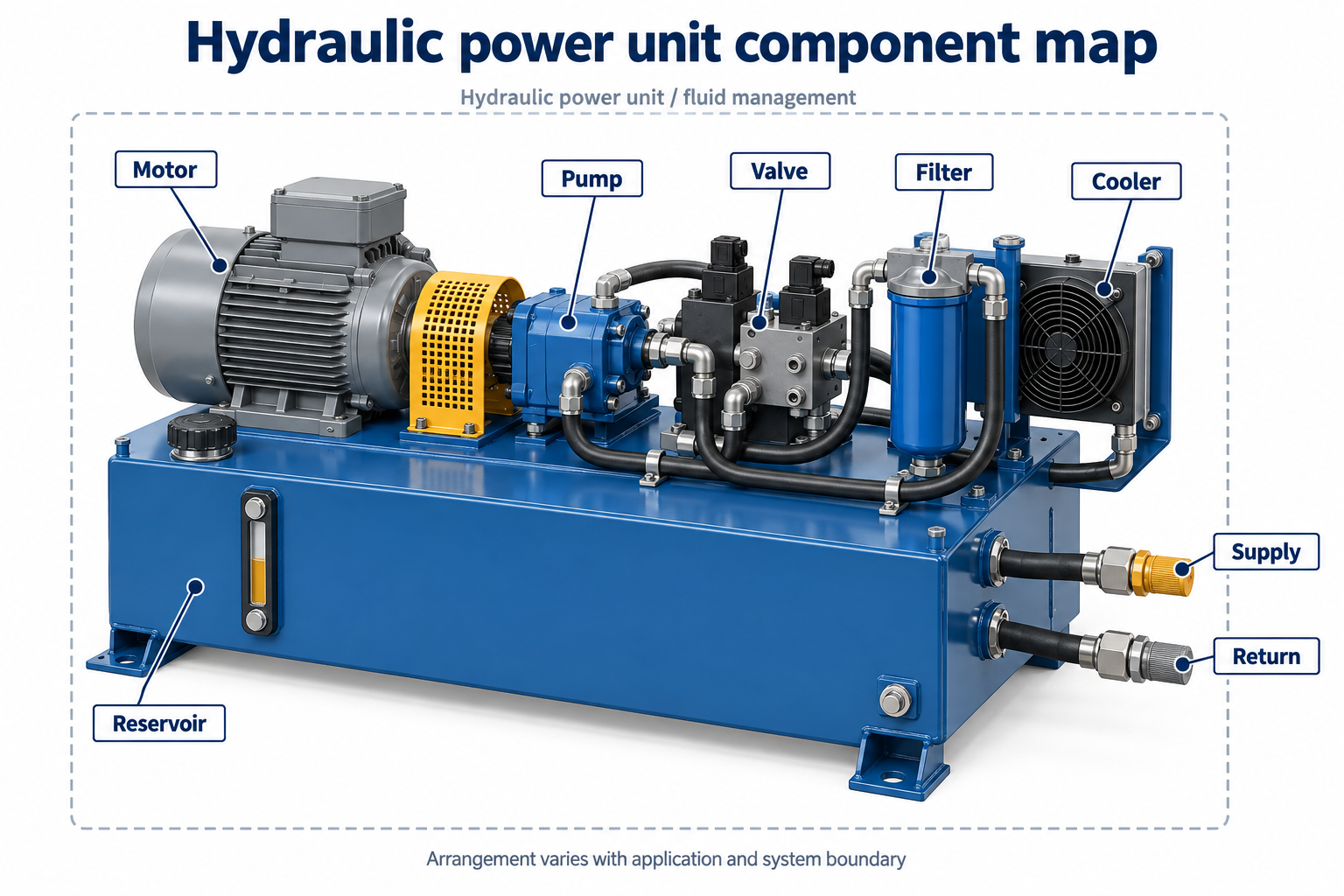
A typical hydraulic power unit includes:
- Electric motor or engine
- 油圧ポンプ
- 貯水池
- 油圧弁
- フィルター
- Pressure-control devices
- Hydraulic fittings
- Electrical control components
The basic energy conversion process is:
Electric motor or engine
↓
Hydraulic pump
↓
Pressurized hydraulic fluid
↓
Control valves
↓
Hydraulic actuator
↓
Mechanical movement
The hydraulic power unit does not directly perform mechanical work. Instead, it supplies hydraulic power to actuators such as:
- 油圧シリンダー
- 油圧モーター
- Hydraulic rotary actuators
The actuator then converts hydraulic energy into movement.
Hydraulic power units are widely used in:
- Lifting equipment
- テールリフト
- ダンプトレーラー
- 農業機械
- Industrial machines
- 油圧プレス
- Material handling systems
- 試験装置
The Basic Hydraulic Power Unit Selection Process
Selecting a hydraulic power unit should start with understanding the machine requirements.
A typical selection process includes:
Step 1: Define the Application
First determine what the hydraulic system needs to do.
Important questions include:
- What machine is the HPU used for?
- Is the movement lifting, pushing, clamping, rotating, or continuous driving?
- What type of actuator is used?
- How frequently does the system operate?
- Is the application mobile or stationary?
Examples:
A small lifting platform may require a compact hydraulic power unit.
A hydraulic press may require a high-pressure industrial power unit.
A mobile machine may require a DC hydraulic power unit powered by batteries.

Step 2: Determine Required Force or Torque
The hydraulic power unit must provide enough energy for the actuator.
For hydraulic cylinders, the required force depends mainly on:
- 使用圧力
- Cylinder bore diameter
- 負荷条件
- Mechanical efficiency
基本的な関係は次のとおりです:
力 = 圧力 × 有効面積
For hydraulic motors, the important parameters are:
- トルク
- 速度
- Displacement
- 圧力
The hydraulic power unit should be selected based on the actual actuator requirement, not only the machine size.
Step 3: Determine Working Pressure
Working pressure is one of the most important parameters in hydraulic power unit selection.
Higher pressure allows:
- Smaller cylinders
- Smaller hydraulic components
- Higher force density
However, higher pressure also increases:
- Component stress
- Leakage risk
- Heat from leakage or pressure-drop losses while flow occurs
- Manufacturing requirements
The selected pressure must match:
- Cylinder rating
- Pump rating
- Valve rating
- Hose rating
- Fitting rating
Common hydraulic power unit pressure ranges depend on application, but the correct pressure should always be based on the complete system design.
A common mistake is selecting the highest possible pressure without considering whether the machine actually needs it.
Step 4: Determine Required Flow Rate
Flow rate determines actuator speed.
For a hydraulic cylinder:
Cylinder speed depends mainly on:

Flow rate ÷ Effective piston area
A larger cylinder requires more flow to achieve the same speed.
流量要件は、以下の要因によって異なります:
- Cylinder bore
- 脳卒中
- Required cycle time
- アクチュエータの数
- Simultaneous movements
Example:
A lifting platform that must raise quickly requires more flow than a similar platform designed for slow movement.
Insufficient flow can cause:
- Slow actuator movement
- Longer cycle time
- Reduced productivity
Excessive flow can cause:
- Higher cost
- Increased heat
- Larger components than necessary
Step 5: Select the Hydraulic Pump
The hydraulic pump is the heart of the hydraulic power unit.
一般的なポンプの種類には、次のようなものがあります:
Gear Pump
メリット:
- Simple structure
- 低コスト
- Good reliability
- Common in compact HPUs
Applications:
- Small lifting systems
- Mobile equipment
- Simple hydraulic circuits
Vane Pump
メリット:
- Lower noise
- Smooth flow
- Good efficiency
Applications:
- Industrial systems
- Medium-pressure applications
Piston Pump
メリット:
- High pressure capability
- High efficiency
- Variable displacement options
Applications:
- Heavy-duty systems
- Mobile hydraulics
- Advanced industrial equipment
Pump selection should consider:
- 必要な流量
- 使用圧力
- 効率
- 騒音に関する要件
- デューティサイクル
- 費用
- 制御要件
Step 6: Select the Motor Power
The motor must provide enough power to drive the hydraulic pump.
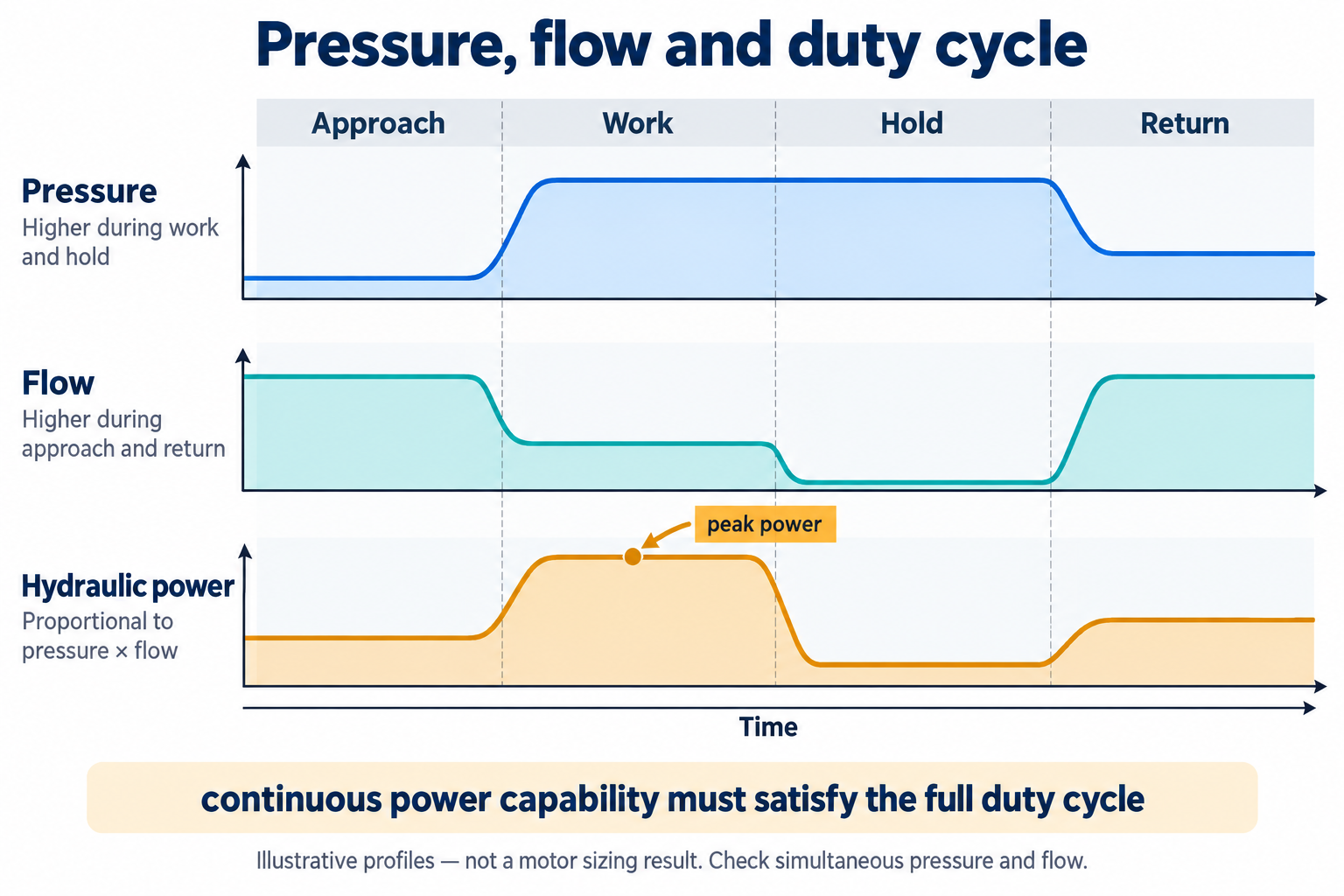
The approximate hydraulic power relationship is:
水力 = 圧力 × 流量
Motor selection must consider:
- Required hydraulic power
- ポンプの効率
- モーターの効率
- 動作条件
- Starting load
An undersized motor may cause:
- 過熱
- Low pressure
- Slow movement
- Motor overload
An oversized motor may increase:
- Initial cost
- Physical size
- エネルギー消費量
The motor should be matched to the actual hydraulic demand.
Step 7: Select Reservoir Capacity
The hydraulic reservoir stores and conditions hydraulic fluid.
The reservoir helps:
- Store sufficient oil
- Remove air bubbles
- 熱を放散する
- Allow contamination settling
- Compensate for fluid expansion
Reservoir size depends on:
- System flow
- デューティサイクル
- 動作温度
- 利用可能な設置スペース
- Cooling requirements
A small intermittent hydraulic system may use a compact reservoir.
A continuously operating industrial system may require a larger reservoir and additional cooling.
Step 8: Select Valve Configuration
The hydraulic valves determine how the hydraulic power unit controls the actuator.
Common valves include:
Directional Control Valves
Control:
- Extension
- Retraction
- 回転方向
- Stop position
Relief Valves
Protect the system from excessive pressure.
Check Valves
Allow flow in one direction and prevent reverse flow.
Flow Control Valves
Adjust actuator speed.
Counterbalance or Load-Holding Valves
Control suspended or overrunning loads.
Valve selection depends on:
- Actuator type
- Motion requirements
- 安全要件
- 制御方法
A simple lifting application may need only basic valves.
A complex machine may require proportional or servo control.
Step 9: Consider AC or DC Hydraulic Power Unit
Hydraulic power units are commonly powered by either AC or DC motors.
AC Hydraulic Power Unit
AC motors are common in fixed industrial equipment.
メリット:
- Suitable for continuous operation
- High power availability
- Easy connection to factory electrical systems
- Good efficiency for large systems
Applications:
- 産業用機械
- 油圧プレス
- Factory automation equipment
- Test systems
DC Hydraulic Power Unit
DC motors are common in mobile equipment.
メリット:
- Battery powered
- Compact
- Easy installation
- Suitable for vehicles
Applications:
- テールリフト
- ダンプトレーラー
- Wheelchair lifts
- Mobile lifting equipment
The choice depends mainly on the available power source and application requirements.
Step 10: Consider Installation Environment
The working environment affects hydraulic power unit design.
重要な要素としては、以下が挙げられます:
温度
Extreme temperatures affect:
- 油の粘度
- Motor performance
- アザラシの生態
- ポンプの効率
汚染
Outdoor equipment may require:
- Better filtration
- Protective covers
- More durable components
Noise Requirements
Noise may be important in:
- Indoor factories
- Medical equipment
- Residential environments
Possible solutions include:
- Lower-speed motors
- Better pump selection
- Sound insulation
Space Limitations
Compact hydraulic power units are often selected where installation space is limited.
However, reducing size may affect:
- Reservoir capacity
- Cooling ability
- Maintenance access
A compact design must still meet performance requirements.
Common Hydraulic Power Unit Configurations
Compact Hydraulic Power Unit
Usually includes:
- Small motor
- Gear pump
- Small reservoir
- Basic valves
Applications:
- Small lifting systems
- Medical equipment
- Access platforms
Mobile Hydraulic Power Unit
Designed for:
- Vehicles
- Battery systems
- Outdoor equipment
Common features:
- DC motor
- Compact structure
- High starting torque
Industrial Hydraulic Power Unit
Designed for:
- Continuous operation
- High power requirements
- Factory machinery
以下が含まれる場合があります:
- Large reservoir
- Variable pump
- Advanced valves
- Cooling systems
- Monitoring sensors
Common Hydraulic Power Unit Selection Mistakes
Mistake 1: Selecting Only Based on Pressure
Pressure alone does not determine the correct HPU.
The system also requires:
- フロー
- アクチュエータのサイズ
- サイクルタイム
- デューティサイクル
Mistake 2: Ignoring Cycle Time
Two machines may use the same cylinder but require different power units.
A slow lifting system and a fast production machine need different flow capabilities.
Mistake 3: Choosing a Pump Before Understanding the System
The pump must match:
- 圧力
- フロー
- モーター出力
- Valve system
- Actuator requirements
Selecting the pump first can lead to an unbalanced system.
Mistake 4: Ignoring Heat Generation
Hydraulic energy losses become heat.
Overheating may result from:
- Excessive pressure loss
- Relief-valve operation
- 内部漏れ
- Undersized reservoir
- Poor cooling
Mistake 5: Providing Too Little Information for Quotation
A request such as:
“I need a hydraulic power unit.”
is not enough.
Engineers need information such as:
- 必要圧力
- 必要な流量
- Motor voltage
- Cylinder size
- 読み込み
- デューティサイクル
- 設置スペース
- 制御要件
What Information Is Needed to Select a Hydraulic Power Unit?
A complete hydraulic power unit specification should include:
Application Information
- 機械の種類
- Function
- 職場環境
油圧に関する要件
- 圧力
- フロー
- Actuator type
- Cylinder size
- Motor or cylinder requirements
電気的要件
- 電圧
- AC or DC
- モーター出力
- 制御電圧
Mechanical Requirements
- Mounting space
- 貯水池の容量
- Port location
- Installation direction
Operating Conditions
- デューティサイクル
- 温度
- 騒音に関する要件
- 安全要件
The more complete the information, the more accurately the hydraulic power unit can be selected.
出力の計算と単位
所定の運転点において、油圧出力(kW)は、圧力差(bar)に流量(L/min)を乗じ、600で割った値となります。ポンプ軸出力は、油圧出力をポンプの総合効率で割った値に等しくなります。また、電気入力には、モーターおよび駆動系の損失も含まれます。 モーターの定格機械出力を必要な軸出力と比較する際は、モーターの効率で割らないでください。始動、過渡、および熱負荷のチェックは別途行います。.
An Illustrative Calculation
For an illustrative 150 bar pressure difference and 20 L/min flow, hydraulic output is 5 kW. If the assumed pump overall efficiency is 0.85, required pump shaft power at that point is approximately 5.88 kW. These values are examples, not equipment recommendations. Motor selection must still check the real duty cycle, efficiency map, starting torque and available supply.
概要
Selecting a hydraulic power unit requires matching the complete hydraulic system, not simply choosing a pump and motor.
The key selection factors include:
- Application requirements
- 圧力
- フロー
- Actuator requirements
- ポンプの種類
- モーター出力
- Reservoir capacity
- Valve configuration
- Power source
- 動作環境
A well-designed hydraulic power unit provides reliable performance, efficient operation, and long service life.
The correct selection process starts with understanding what the machine needs to do, then matching each hydraulic component to that requirement.
よくある質問
How do I choose a hydraulic power unit?
Start by defining the application, required force or torque, working pressure, flow rate, actuator type, duty cycle, available power source, and installation requirements.
What size hydraulic power unit do I need?
The required size depends on pressure, flow, actuator requirements, operating cycle, and machine load. There is no correct size without application information.
How do I calculate hydraulic power unit motor size?
Motor power depends mainly on hydraulic pressure, flow rate, pump efficiency, and operating conditions.
What pressure should a hydraulic power unit have?
The required pressure depends on the actuator force requirement and system design. Higher pressure is not automatically better: component ratings, leakage and losses at the actual operating point must be checked.
What information is needed for hydraulic power unit quotation?
重要な情報には、以下のものが含まれます:
- 圧力
- フロー
- Motor voltage
- ポンプの種類
- Actuator details
- 用途
- デューティサイクル
- Installation requirements
What is the difference between AC and DC hydraulic power units?
AC hydraulic power units are common in fixed industrial systems. DC hydraulic power units are common in mobile equipment where battery power is available.
技術情報源および参考文献
ここで論じた範囲および技術的な違いを裏付ける情報源: ボッシュ・レックスロス製油圧動力ユニット;Parker Hydraulic Power Units Installation and Maintenance Manual HY28-2600-550-M1/USA;ISO 18464:2025 Design Methodology for Energy Efficient Hydraulic Systems。 詳細な規格条項、適用範囲、および機械固有の手順については、使用前に技術的な確認が必要です。.
関連記事
申請書の審査についてサポートが必要ですか? 技術審査のために、運転条件、負荷および動作要件、図面をご用意ください。.
関連記事

油圧システムとは? 構成部品と動作に関する実践ガイド

産業用機械向け油圧システム:用途、構成部品、および設計上の考慮事項

油圧ユニットで圧力が上がらないのはなぜ? トラブルシューティングの手順ガイド
この油圧に関する知識を応用する上で、お手伝いが必要ですか?
図面、写真、使用圧力、機器の詳細、または用途に関するご質問などをお送りください。.