How to Select a Hydraulic Power Unit: Pressure, Flow, Motor, and Pump Selection
Select a hydraulic power unit around actuator force, speed and duty cycle, then check pressure, flow, pump drive power, reservoir, controls and cooling.

A hydraulic power unit (HPU) is the energy source of a hydraulic system. Selecting the correct hydraulic power unit requires more than choosing a pump and motor. The complete unit must be matched according to the machine requirements, including pressure, flow, actuator size, duty cycle, installation space, and operating environment.
A properly selected hydraulic power unit can provide reliable performance, efficient operation, and long service life. An incorrectly selected unit may cause problems such as insufficient force, slow movement, overheating, excessive noise, unstable operation, or premature component failure.
The key factors for selecting a hydraulic power unit include:
- Required working pressure
- Required flow rate
- Hydraulic actuator requirements
- Pump displacement
- Motor power
- Reservoir capacity
- Valve configuration
- Electrical supply
- Operating environment
- Duty cycle
This guide explains how engineers select a hydraulic power unit step by step.
Contents
- What Is a Hydraulic Power Unit?
- The Basic Hydraulic Power Unit Selection Process
- Step 1: Define the Application
- Step 2: Determine Required Force or Torque
- Step 3: Determine Working Pressure
- Step 4: Determine Required Flow Rate
- Step 5: Select the Hydraulic Pump
- Step 6: Select the Motor Power
- Step 7: Select Reservoir Capacity
- Step 8: Select Valve Configuration
- Step 9: Consider AC or DC Hydraulic Power Unit
- Step 10: Consider Installation Environment
- Common Hydraulic Power Unit Configurations
- Common Hydraulic Power Unit Selection Mistakes
- What Information Is Needed to Select a Hydraulic Power Unit?
- Power Calculations and Units
- An Illustrative Calculation
- Summary
- FAQ
- Technical Sources and Reading
- Related Articles
What Is a Hydraulic Power Unit?
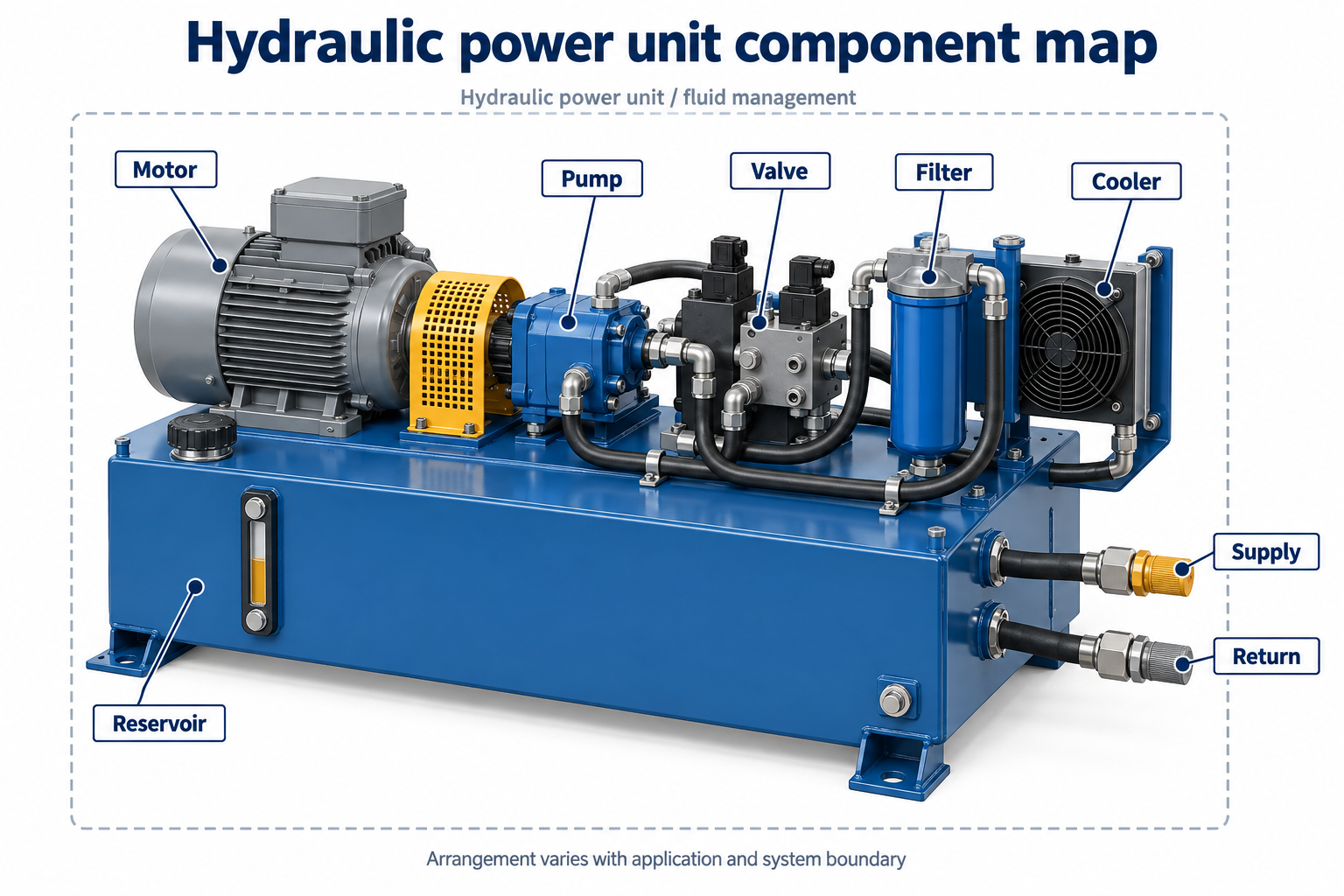
A hydraulic power unit is a complete hydraulic assembly that generates and controls hydraulic energy for a machine or system.
A typical hydraulic power unit includes:
- Electric motor or engine
- Hydraulic pump
- Reservoir
- Hydraulic valves
- Filters
- Pressure-control devices
- Hydraulic fittings
- Electrical control components
The basic energy conversion process is:
Electric motor or engine
↓
Hydraulic pump
↓
Pressurized hydraulic fluid
↓
Control valves
↓
Hydraulic actuator
↓
Mechanical movement
The hydraulic power unit does not directly perform mechanical work. Instead, it supplies hydraulic power to actuators such as:
- Hydraulic cylinders
- Hydraulic motors
- Hydraulic rotary actuators
The actuator then converts hydraulic energy into movement.
Hydraulic power units are widely used in:
- Lifting equipment
- Tail lifts
- Dump trailers
- Agricultural machinery
- Industrial machines
- Hydraulic presses
- Material handling systems
- Test equipment
The Basic Hydraulic Power Unit Selection Process
Selecting a hydraulic power unit should start with understanding the machine requirements.
A typical selection process includes:
Step 1: Define the Application
First determine what the hydraulic system needs to do.
Important questions include:
- What machine is the HPU used for?
- Is the movement lifting, pushing, clamping, rotating, or continuous driving?
- What type of actuator is used?
- How frequently does the system operate?
- Is the application mobile or stationary?
Examples:
A small lifting platform may require a compact hydraulic power unit.
A hydraulic press may require a high-pressure industrial power unit.
A mobile machine may require a DC hydraulic power unit powered by batteries.

Step 2: Determine Required Force or Torque
The hydraulic power unit must provide enough energy for the actuator.
For hydraulic cylinders, the required force depends mainly on:
- Working pressure
- Cylinder bore diameter
- Load condition
- Mechanical efficiency
The basic relationship is:
Force = Pressure × Effective Area
For hydraulic motors, the important parameters are:
- Torque
- Speed
- Displacement
- Pressure
The hydraulic power unit should be selected based on the actual actuator requirement, not only the machine size.
Step 3: Determine Working Pressure
Working pressure is one of the most important parameters in hydraulic power unit selection.
Higher pressure allows:
- Smaller cylinders
- Smaller hydraulic components
- Higher force density
However, higher pressure also increases:
- Component stress
- Leakage risk
- Heat from leakage or pressure-drop losses while flow occurs
- Manufacturing requirements
The selected pressure must match:
- Cylinder rating
- Pump rating
- Valve rating
- Hose rating
- Fitting rating
Common hydraulic power unit pressure ranges depend on application, but the correct pressure should always be based on the complete system design.
A common mistake is selecting the highest possible pressure without considering whether the machine actually needs it.
Step 4: Determine Required Flow Rate
Flow rate determines actuator speed.
For a hydraulic cylinder:
Cylinder speed depends mainly on:

Flow rate ÷ Effective piston area
A larger cylinder requires more flow to achieve the same speed.
Flow requirement depends on:
- Cylinder bore
- Stroke
- Required cycle time
- Number of actuators
- Simultaneous movements
Example:
A lifting platform that must raise quickly requires more flow than a similar platform designed for slow movement.
Insufficient flow can cause:
- Slow actuator movement
- Longer cycle time
- Reduced productivity
Excessive flow can cause:
- Higher cost
- Increased heat
- Larger components than necessary
Step 5: Select the Hydraulic Pump
The hydraulic pump is the heart of the hydraulic power unit.
Common pump types include:
Gear Pump
Advantages:
- Simple structure
- Lower cost
- Good reliability
- Common in compact HPUs
Applications:
- Small lifting systems
- Mobile equipment
- Simple hydraulic circuits
Vane Pump
Advantages:
- Lower noise
- Smooth flow
- Good efficiency
Applications:
- Industrial systems
- Medium-pressure applications
Piston Pump
Advantages:
- High pressure capability
- High efficiency
- Variable displacement options
Applications:
- Heavy-duty systems
- Mobile hydraulics
- Advanced industrial equipment
Pump selection should consider:
- Required flow
- Working pressure
- Efficiency
- Noise requirement
- Duty cycle
- Cost
- Control requirements
Step 6: Select the Motor Power
The motor must provide enough power to drive the hydraulic pump.
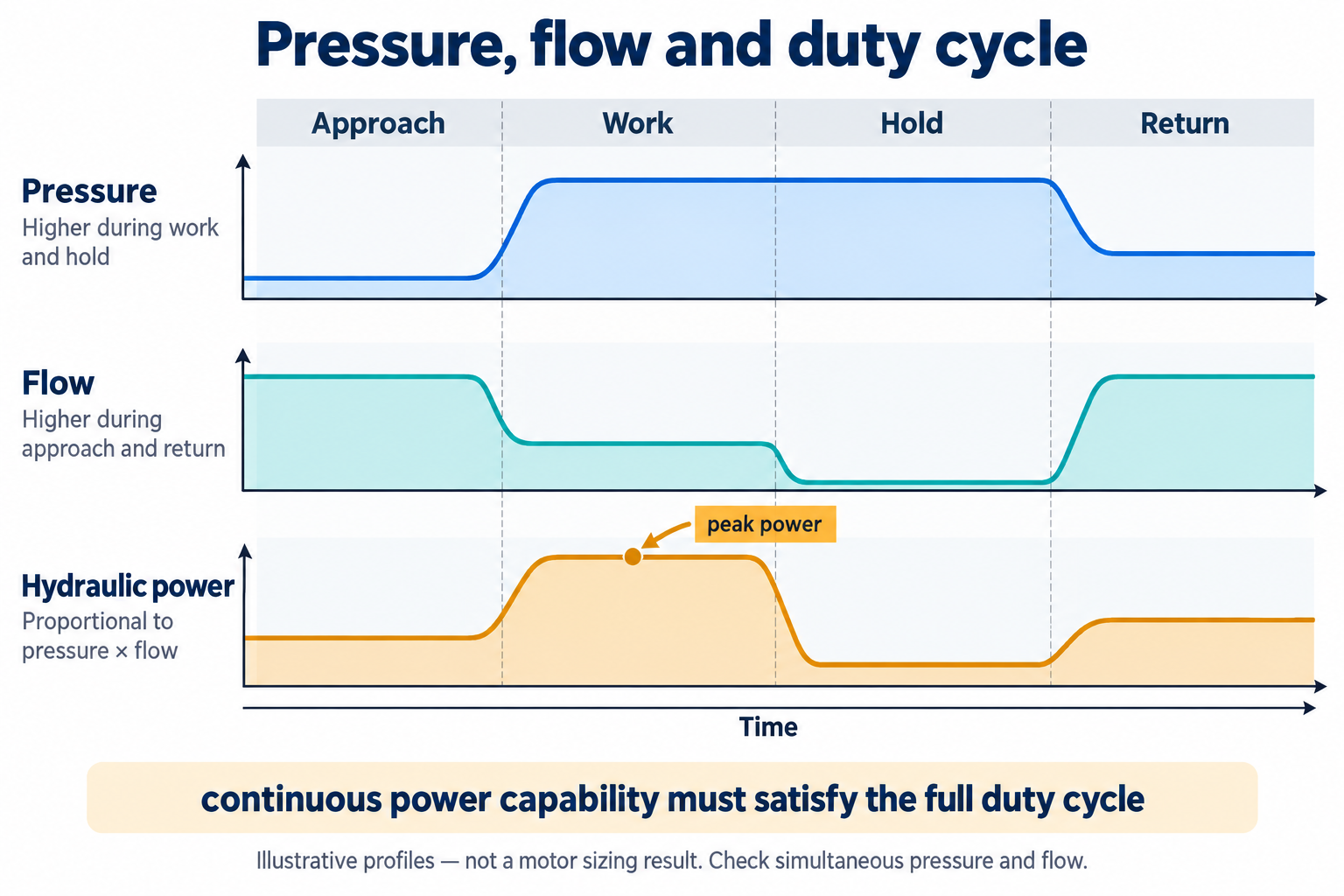
The approximate hydraulic power relationship is:
Hydraulic Power = Pressure × Flow
Motor selection must consider:
- Required hydraulic power
- Pump efficiency
- Motor efficiency
- Operating conditions
- Starting load
An undersized motor may cause:
- Overheating
- Low pressure
- Slow movement
- Motor overload
An oversized motor may increase:
- Initial cost
- Physical size
- Energy consumption
The motor should be matched to the actual hydraulic demand.
Step 7: Select Reservoir Capacity
The hydraulic reservoir stores and conditions hydraulic fluid.
The reservoir helps:
- Store sufficient oil
- Remove air bubbles
- Dissipate heat
- Allow contamination settling
- Compensate for fluid expansion
Reservoir size depends on:
- System flow
- Duty cycle
- Operating temperature
- Available installation space
- Cooling requirements
A small intermittent hydraulic system may use a compact reservoir.
A continuously operating industrial system may require a larger reservoir and additional cooling.
Step 8: Select Valve Configuration
The hydraulic valves determine how the hydraulic power unit controls the actuator.
Common valves include:
Directional Control Valves
Control:
- Extension
- Retraction
- Rotation direction
- Stop position
Relief Valves
Protect the system from excessive pressure.
Check Valves
Allow flow in one direction and prevent reverse flow.
Flow Control Valves
Adjust actuator speed.
Counterbalance or Load-Holding Valves
Control suspended or overrunning loads.
Valve selection depends on:
- Actuator type
- Motion requirements
- Safety requirements
- Control method
A simple lifting application may need only basic valves.
A complex machine may require proportional or servo control.
Step 9: Consider AC or DC Hydraulic Power Unit
Hydraulic power units are commonly powered by either AC or DC motors.
AC Hydraulic Power Unit
AC motors are common in fixed industrial equipment.
Advantages:
- Suitable for continuous operation
- High power availability
- Easy connection to factory electrical systems
- Good efficiency for large systems
Applications:
- Industrial machinery
- Hydraulic presses
- Factory automation equipment
- Test systems
DC Hydraulic Power Unit
DC motors are common in mobile equipment.
Advantages:
- Battery powered
- Compact
- Easy installation
- Suitable for vehicles
Applications:
- Tail lifts
- Dump trailers
- Wheelchair lifts
- Mobile lifting equipment
The choice depends mainly on the available power source and application requirements.
Step 10: Consider Installation Environment
The working environment affects hydraulic power unit design.
Important factors include:
Temperature
Extreme temperatures affect:
- Oil viscosity
- Motor performance
- Seal life
- Pump efficiency
Contamination
Outdoor equipment may require:
- Better filtration
- Protective covers
- More durable components
Noise Requirements
Noise may be important in:
- Indoor factories
- Medical equipment
- Residential environments
Possible solutions include:
- Lower-speed motors
- Better pump selection
- Sound insulation
Space Limitations
Compact hydraulic power units are often selected where installation space is limited.
However, reducing size may affect:
- Reservoir capacity
- Cooling ability
- Maintenance access
A compact design must still meet performance requirements.
Common Hydraulic Power Unit Configurations
Compact Hydraulic Power Unit
Usually includes:
- Small motor
- Gear pump
- Small reservoir
- Basic valves
Applications:
- Small lifting systems
- Medical equipment
- Access platforms
Mobile Hydraulic Power Unit
Designed for:
- Vehicles
- Battery systems
- Outdoor equipment
Common features:
- DC motor
- Compact structure
- High starting torque
Industrial Hydraulic Power Unit
Designed for:
- Continuous operation
- High power requirements
- Factory machinery
May include:
- Large reservoir
- Variable pump
- Advanced valves
- Cooling systems
- Monitoring sensors
Common Hydraulic Power Unit Selection Mistakes
Mistake 1: Selecting Only Based on Pressure
Pressure alone does not determine the correct HPU.
The system also requires:
- Flow
- Actuator size
- Cycle time
- Duty cycle
Mistake 2: Ignoring Cycle Time
Two machines may use the same cylinder but require different power units.
A slow lifting system and a fast production machine need different flow capabilities.
Mistake 3: Choosing a Pump Before Understanding the System
The pump must match:
- Pressure
- Flow
- Motor power
- Valve system
- Actuator requirements
Selecting the pump first can lead to an unbalanced system.
Mistake 4: Ignoring Heat Generation
Hydraulic energy losses become heat.
Overheating may result from:
- Excessive pressure loss
- Relief-valve operation
- Internal leakage
- Undersized reservoir
- Poor cooling
Mistake 5: Providing Too Little Information for Quotation
A request such as:
“I need a hydraulic power unit.”
is not enough.
Engineers need information such as:
- Required pressure
- Required flow
- Motor voltage
- Cylinder size
- Load
- Duty cycle
- Installation space
- Control requirements
What Information Is Needed to Select a Hydraulic Power Unit?
A complete hydraulic power unit specification should include:
Application Information
- Machine type
- Function
- Working environment
Hydraulic Requirements
- Pressure
- Flow
- Actuator type
- Cylinder size
- Motor or cylinder requirements
Electrical Requirements
- Voltage
- AC or DC
- Motor power
- Control voltage
Mechanical Requirements
- Mounting space
- Reservoir size
- Port location
- Installation direction
Operating Conditions
- Duty cycle
- Temperature
- Noise requirements
- Safety requirements
The more complete the information, the more accurately the hydraulic power unit can be selected.
Power Calculations and Units
At a defined operating point, hydraulic power in kW is pressure difference in bar multiplied by flow in L/min, divided by 600. Pump shaft power equals hydraulic power divided by pump overall efficiency; electrical input additionally includes motor and drive losses. Do not divide by motor efficiency when comparing a motor's rated mechanical output with required shaft power. Starting, transient and thermal duty checks are separate.
An Illustrative Calculation
For an illustrative 150 bar pressure difference and 20 L/min flow, hydraulic output is 5 kW. If the assumed pump overall efficiency is 0.85, required pump shaft power at that point is approximately 5.88 kW. These values are examples, not equipment recommendations. Motor selection must still check the real duty cycle, efficiency map, starting torque and available supply.
Summary
Selecting a hydraulic power unit requires matching the complete hydraulic system, not simply choosing a pump and motor.
The key selection factors include:
- Application requirements
- Pressure
- Flow
- Actuator requirements
- Pump type
- Motor power
- Reservoir capacity
- Valve configuration
- Power source
- Operating environment
A well-designed hydraulic power unit provides reliable performance, efficient operation, and long service life.
The correct selection process starts with understanding what the machine needs to do, then matching each hydraulic component to that requirement.
FAQ
How do I choose a hydraulic power unit?
Start by defining the application, required force or torque, working pressure, flow rate, actuator type, duty cycle, available power source, and installation requirements.
What size hydraulic power unit do I need?
The required size depends on pressure, flow, actuator requirements, operating cycle, and machine load. There is no correct size without application information.
How do I calculate hydraulic power unit motor size?
Motor power depends mainly on hydraulic pressure, flow rate, pump efficiency, and operating conditions.
What pressure should a hydraulic power unit have?
The required pressure depends on the actuator force requirement and system design. Higher pressure is not automatically better: component ratings, leakage and losses at the actual operating point must be checked.
What information is needed for hydraulic power unit quotation?
Important information includes:
- Pressure
- Flow
- Motor voltage
- Pump type
- Actuator details
- Application
- Duty cycle
- Installation requirements
What is the difference between AC and DC hydraulic power units?
AC hydraulic power units are common in fixed industrial systems. DC hydraulic power units are common in mobile equipment where battery power is available.
Technical Sources and Reading
Sources supporting the scope and technical distinctions discussed here: Bosch Rexroth Hydraulic Power Units;Parker Hydraulic Power Units Installation and Maintenance Manual HY28-2600-550-M1/USA;ISO 18464:2025 Design Methodology for Energy Efficient Hydraulic Systems。 Detailed standards clauses, application limits and machine-specific procedures require engineering review before use.
Related Articles
- What Is a Hydraulic System?
- Hydraulic Systems for Industrial Machinery
- Why Is a Hydraulic Power Unit Not Building Pressure?
Need help reviewing an application? Prepare the operating conditions, load and motion requirements, and drawing for an engineering review.
Related Articles

What Is a Hydraulic System? A Practical Guide to Components and Operation

Hydraulic Systems for Industrial Machinery: Applications, Components, and Design Considerations

Why Is a Hydraulic Power Unit Not Building Pressure? A Step-by-Step Troubleshooting Guide
Need help applying this hydraulic knowledge?
Send us your drawings, photos, operating pressure, equipment details, or application questions.