Hydraulic Test Bench Buyer’s Checklist: 24 Requirements to Define Before Purchasing
Use this hydraulic test bench buyer’s checklist to define the DUT, standards, pressure, flow, measurement, safety, deliverables and FAT/SAT acceptance scope.

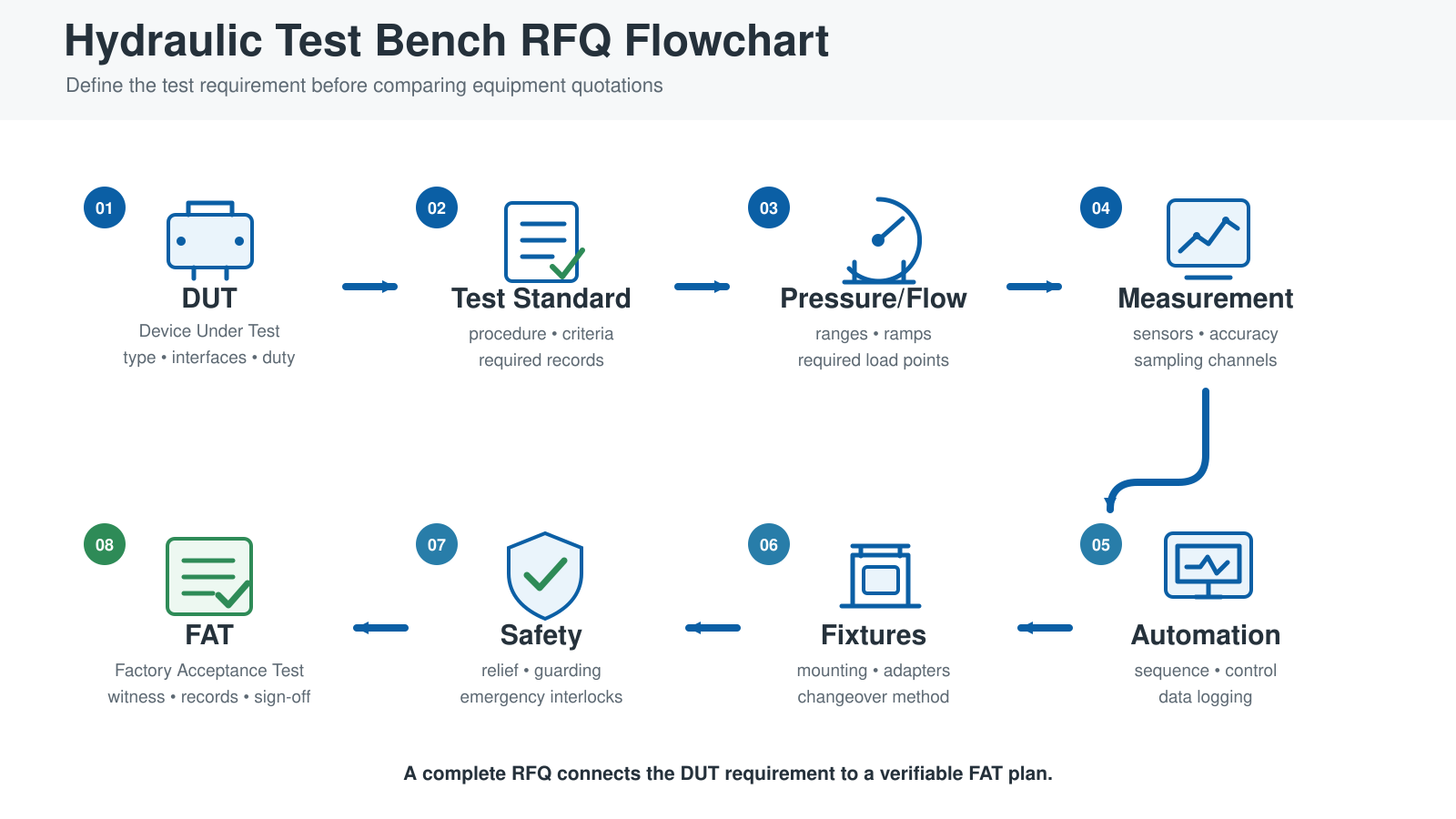
Buying a hydraulic test bench is not the same as buying a standard hydraulic power unit.
A test bench is built around a test requirement. Two benches with the same maximum pressure may have very different capabilities depending on flow, power, measurement accuracy, automation, fixtures, data acquisition, temperature control, and safety systems.
The most important rule when preparing a hydraulic test bench RFQ is:
Do not start with the test bench. Start with the component you need to test and the result you need to obtain.
Different hydraulic components have different test methods. ISO 10100:2020 specifies acceptance and function tests for hydraulic cylinders; ISO 4409:2019 covers steady-state performance testing of positive-displacement pumps, motors, and integral transmissions; ISO 6605:2017 specifies test methods for hydraulic hoses and hose assemblies.
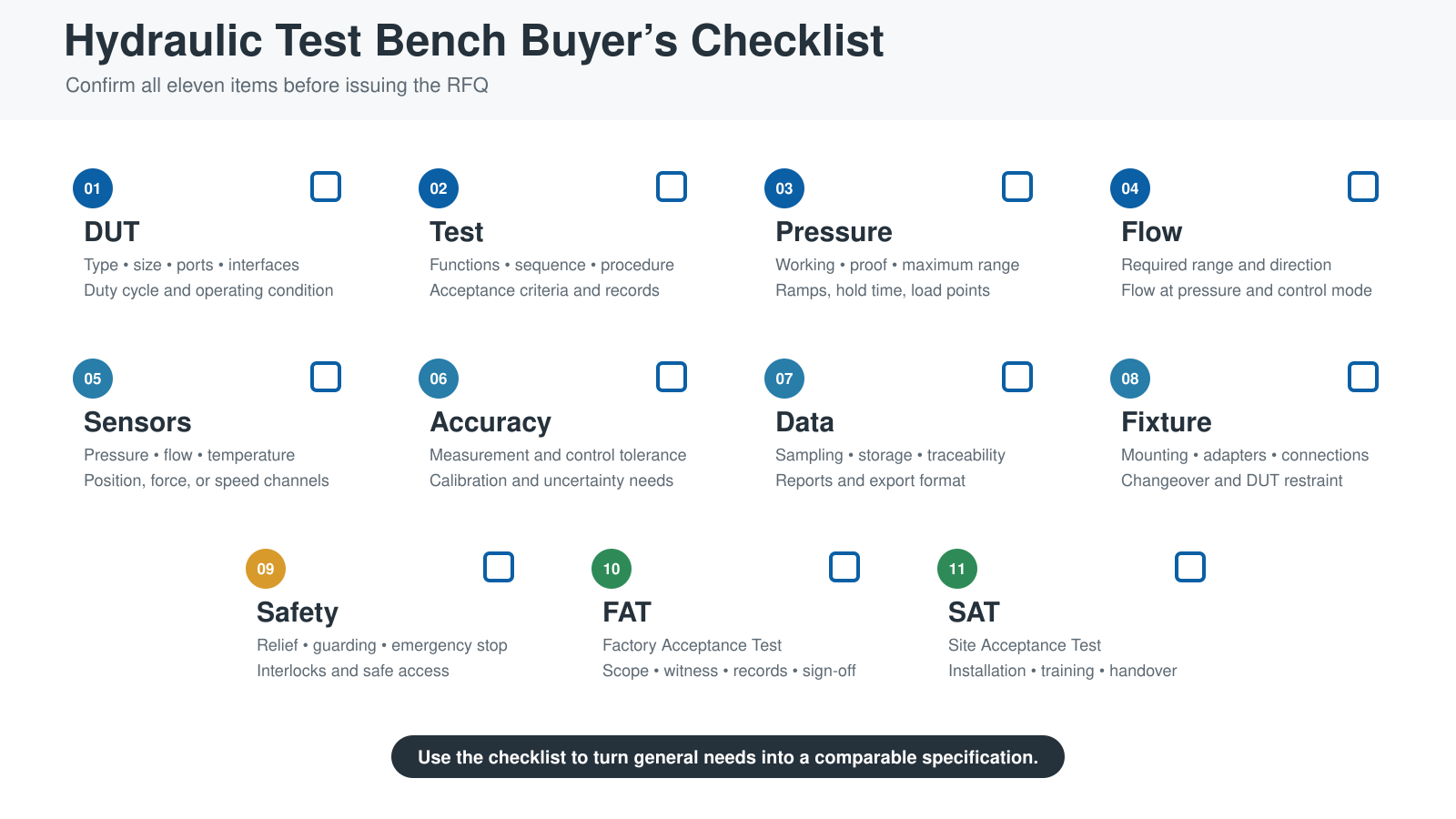
This buyer's checklist can be used before requesting quotations, during technical comparison, and before final acceptance of a hydraulic test bench.
Contents
- 1. Define the Device Under Test — DUT
- 2. Define the Purpose of the Test
- 3. List Every Required Test
- 4. State the Applicable Standard or Test Procedure
- 5. Define the Pressure Range
- 6. Define the Required Flow Range
- 7. Define Installed Power
- 8. Specify the Hydraulic Fluid
- 9. Define Temperature-Control Requirements
- 10. Define Every Required Measurement Channel
- 11. Specify Accuracy, Calibration, and Traceability
- 12. Decide the Required Level of Automation
- 13. Define Data Acquisition and Reporting
- 14. Define Fixtures and Mechanical Interfaces
- 15. Define Contamination-Control Requirements
- 16. Define Safety Requirements Before Quotation
- 17. State the Available Factory Utilities
- 18. Specify Environmental Requirements
- 19. Request Documentation Before Purchase
- 20. Define FAT — Factory Acceptance Test
- 21. Define SAT — Site Acceptance Test
- 22. Ask About Training
- 23. Ask About Spare Parts and Service
- 24. Define Future Expansion
- Hydraulic Test Bench RFQ Checklist
- How to Compare Two Hydraulic Test Bench Quotations
- Ten Questions to Ask Before Placing the Order
- Measurement and Acceptance Boundaries
- Summary
- FAQ
- Technical Sources and Reading
- Related Articles
1. Define the Device Under Test — DUT
The first item in the RFQ should be:
What exactly will the bench test?
Possible DUTs include:
- Hydraulic cylinders
- Hydraulic pumps
- Hydraulic motors
- Hydraulic valves
- Hydraulic manifolds
- Hydraulic power units
- Hoses and hose assemblies
- Accumulators
- Complete hydraulic assemblies
Do not write only:
"Hydraulic component test bench."
Instead, define the actual product range.
For example:
Hydraulic cylinder test bench for welded double-acting cylinders, covering bore sizes from ___ to ___, stroke up to ___, maximum retracted length ___, maximum weight ___.
Or:
Hydraulic pump test bench for gear and piston pumps, with displacement range ___, maximum shaft speed ___, maximum flow ___, and maximum test pressure ___.
The mechanical and hydraulic requirements of a cylinder bench are fundamentally different from those of a pump or motor test bench. Current ISO test standards are also separated by component type rather than by a universal "hydraulic test bench" standard.
2. Define the Purpose of the Test
Next, state why the component is being tested.
Common purposes include:
- Production acceptance
- End-of-line inspection
- Repair verification
- Research and development
- Performance mapping
- Durability testing
- Failure analysis
- Quality audit
- Customer witness testing
This matters because the required test bench architecture can change significantly.
A production acceptance bench may prioritize:
- Fast cycle time
- Repeatability
- Automatic pass/fail
- Serial-number traceability
A development bench may prioritize:
- More measurement channels
- Flexible control
- High sampling rates
- Curve analysis
- Easy reconfiguration
Bosch Rexroth describes hydraulic test systems as combinations of hydraulic supply, automation, manifolds, servo or control valves, and test actuators adapted to the specific testing task rather than one fixed universal configuration.
3. List Every Required Test
Do not simply say:
"The bench must test hydraulic cylinders."
Define the individual tests.
For a cylinder, for example:
| Test | Required? | Target / Procedure |
|---|---|---|
| Extension and retraction function | Yes / No | |
| Pressure / proof test | Yes / No | |
| External leakage | Yes / No | |
| Internal leakage | Yes / No | |
| Stroke measurement | Yes / No | |
| Cushion test | Yes / No | |
| Cycle test | Yes / No | |
| Position measurement | Yes / No | |
| Speed measurement | Yes / No |
For pumps and motors, typical performance variables include pressure, flow, rotational speed, torque, temperature, and efficiency-related calculations; ISO 4409:2019 specifically provides methods for testing and presenting basic steady-state performance of positive-displacement pumps, motors, and integral transmissions.
A buyer should therefore attach the actual test procedure or customer specification whenever one already exists.
4. State the Applicable Standard or Test Procedure
Never assume the test bench supplier knows which standard you intend to use.
Specify:
- Standard number
- Standard revision/year
- Customer specification
- Internal company procedure
- Acceptance criteria
Examples include:
- ISO 10100:2020 for hydraulic cylinder acceptance and function tests
- ISO 4409:2019 for positive-displacement pump and motor steady-state performance testing
- ISO 6605:2017 for hoses and hose assemblies
If no formal standard applies, provide your own approved procedure.
Do not ask the supplier to invent acceptance criteria after the bench has already been built.
5. Define the Pressure Range
State:
- Minimum useful test pressure
- Normal test pressure
- Maximum test pressure
- Required pressure ramp
- Pressure-holding time
- Pressure-control tolerance
- Whether multiple pressure ranges are required
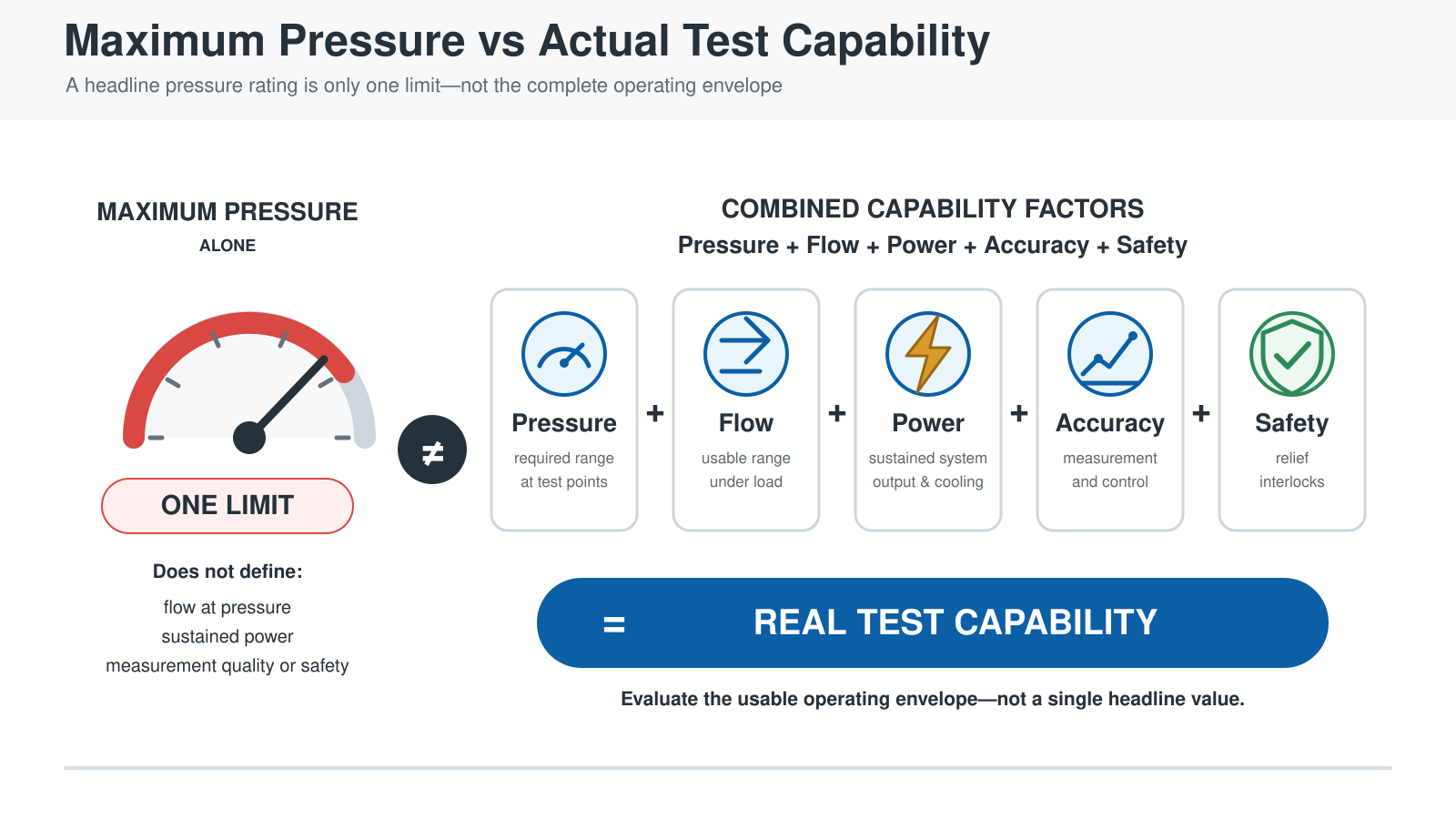
Maximum pressure alone is not enough.
For example, if most tests are performed at relatively low pressure but the bench must occasionally reach a much higher pressure, one very high-range sensor may not provide the measurement performance required throughout the full operating range.
The pressure measurement architecture should therefore be discussed together with accuracy and calibration requirements.
6. Define the Required Flow Range
State:
- Minimum controllable flow
- Normal operating flow
- Maximum flow
- Whether bidirectional flow is required
- Whether maximum pressure and maximum flow must occur simultaneously
This last question is particularly important.
A supplier may quote:
Maximum pressure: X Maximum flow: Y
but the system may not have enough installed power to provide both at the same time.
Hydraulic test systems should therefore be compared using the complete pressure-flow operating envelope, not two isolated maximum values.
7. Define Installed Power
Pressure and flow determine hydraulic power demand.
The buyer should clarify:
- Maximum simultaneous pressure and flow
- Motor power
- Available electrical supply
- Whether regeneration or energy recovery is required
- Expected test duty cycle
Full-load component testing can require substantial energy. Parker has documented test applications in which hydraulic pumps, motors, cylinders, and valves are tested at load, and has described energy-recovery drive concepts specifically for component test operations.
For large test benches, power architecture should therefore be evaluated early rather than after pressure and flow have already been fixed.
8. Specify the Hydraulic Fluid
Define:
- Fluid type
- Viscosity grade
- Required operating temperature
- Compatibility requirements
- Cleanliness requirements
- Whether different fluids will be tested
Hydraulic fluid selection and cleanliness affect reliability, lubrication, component life, and measurement repeatability. Bosch Rexroth specifically identifies fluid quality and cleanliness as important to the operational safety, efficiency, and service life of hydraulic systems.
If the bench must switch between incompatible fluids, this should be treated as a major design requirement rather than a minor option.
9. Define Temperature-Control Requirements
Ask:
- Is oil heating required?
- Is cooling required?
- What temperature range is required?
- What temperature stability is required?
- Where will temperature be measured?
- Must the test wait until oil temperature stabilizes?
Temperature affects hydraulic-fluid viscosity and therefore can affect leakage, pressure loss, component efficiency, and repeatability.
For simple proof testing, very precise thermal control may not be necessary.
For pump, motor, valve, and performance testing, it can become much more important.
10. Define Every Required Measurement Channel
Typical hydraulic test measurements can include:
- Pressure
- Flow
- Temperature
- Cylinder position
- Stroke
- Linear speed
- Rotational speed
- Torque
- Force
- Leakage
- Time
- Electrical current
- Voltage
HYDAC measurement systems intended for hydraulic diagnostics and test rigs support variables including pressure, temperature, flow rate, and linear position, illustrating the range of measurements commonly required in hydraulic testing.
For every measurement channel, specify:
| Variable | Range | Accuracy | Sampling Rate | Quantity |
|---|---|---|---|---|
| Pressure | ||||
| Flow | ||||
| Temperature | ||||
| Position | ||||
| Torque | ||||
| Speed |
This table is far more useful than simply writing:
"High-accuracy sensors required."
11. Specify Accuracy, Calibration, and Traceability
Do not confuse:
- Range
- Resolution
- Accuracy
- Repeatability
- Measurement uncertainty
They are different requirements.
Before ordering, define:
- Required accuracy for each measurement
- Required calibration certificates
- Calibration interval
- Whether calibration must be traceable
- Whether calibration certificates must be supplied with the bench
- Whether field recalibration must be possible
The complete measurement chain should be considered:
Sensor
→ Signal conditioning
→ Data acquisition
→ Software
→ Calculated result
→ Test report
A high-quality sensor alone does not guarantee a high-quality final test result.
12. Decide the Required Level of Automation
Choose among:
Manual
Suitable when:
- Test volume is low
- Procedures vary frequently
- Operators need high flexibility
- Automatic traceability is not required
Semi-Automatic
May include:
- PLC control
- Automatic pressure steps
- Digital measurement
- Automatic data recording
- Operator-selected recipes
Fully Automatic
May include:
- Barcode or serial-number input
- Automatic fixture confirmation
- Automatic test sequence
- Pressure and flow profiles
- Automatic pass/fail
- Data storage
- Automatic report generation
- Database or MES interface
Bosch Rexroth's current testing-technology portfolio explicitly integrates hydraulic supply, manifolds, automation, control technology, and test actuators, demonstrating that automation should be considered as part of the entire test architecture.
Do not buy more automation simply because it sounds advanced.
Buy the automation that improves:
- Repeatability
- Productivity
- Traceability
- Safety
13. Define Data Acquisition and Reporting
This is one of the most frequently underestimated purchasing items.
Ask:
- Must live curves be displayed?
- How many channels are recorded?
- What sampling rate is required?
- How long must raw data be stored?
- Is serial-number traceability needed?
- Is automatic pass/fail required?
- Is PDF report generation required?
- Is CSV or Excel export required?
- Is database connectivity needed?
- Must the software support user permissions?
- Is remote support required?
Modern hydraulic measurement systems can record several simultaneous sensor types and display dynamic machine processes as measurement curves.
For production use, also define:
Who owns the raw test data, and can it be exported without proprietary software?
This can become very important years after the original test bench purchase.
14. Define Fixtures and Mechanical Interfaces
A test bench can have excellent hydraulic performance and still be inefficient if changing the DUT takes too long.
Specify:
- Maximum DUT length
- Minimum DUT length
- Maximum width and height
- Maximum weight
- Mounting type
- Port locations
- Shaft type
- Flange type
- Coupling requirements
- Adapter requirements
- Changeover time target
For a cylinder bench, consider:
- Clevis
- Trunnion
- Flange
- Pin mounts
- Different stroke lengths
For a pump or motor bench, consider:
- Shaft coupling
- Mounting flange
- Rotation direction
- Port adapters
- Load unit
Ask the supplier to include a fixture and adapter list in the quotation.
15. Define Contamination-Control Requirements
A test bench can spread contamination between components if this is not considered in the original design.
Specify:
- Pressure filtration
- Return filtration
- Offline filtration
- Breather filtration
- Filter monitoring
- Oil sampling points
- Flushing procedure
- Required cleanliness level
- Whether failed/dirty components will be tested
This is particularly important for repair test benches.
A damaged pump or motor can introduce wear debris into the test circuit and contaminate the next DUT.
Fluid cleanliness is an important determinant of hydraulic-system reliability and component service life.
16. Define Safety Requirements Before Quotation
Hydraulic test systems can involve:
- High pressure
- Heavy loads
- Dynamic movement
- Hot fluid
- Rotating shafts
- Stored hydraulic energy
- Component rupture
- Hose failure
Bosch Rexroth specifically notes that hydraulic test systems can involve heavy loads, high pressures, and highly dynamic movements.
ISO 4413:2010 specifies general rules and safety requirements for hydraulic fluid-power systems and components used on machinery.
Depending on the actual test bench, specify requirements such as:
- Enclosed test chamber
- Mechanical guarding
- Safety-door interlock
- Emergency stop
- Automatic pressure relief
- Safe depressurization
- Rupture containment
- Hose-failure protection
- Rotating-shaft guard
- Oil collection
- Overtemperature protection
- Safety monitoring
Safety should be included in the original test-bench architecture, not added as an accessory at the end.
17. State the Available Factory Utilities
The supplier needs to know what infrastructure is available.
Specify:
- Electrical voltage
- Frequency
- Number of phases
- Maximum available electrical power
- Cooling-water availability
- Cooling-water temperature
- Compressed-air availability
- Drainage
- Ventilation
- Network connection
- Floor loading
- Door size
- Crane or forklift access
Large test benches can become difficult to install if these items are discovered only after delivery.
18. Specify Environmental Requirements
Include:
- Ambient temperature
- Humidity
- Indoor or outdoor installation
- Dust
- Corrosive environment
- Noise requirement
- Explosion-risk area, if applicable
- Altitude, where relevant
These conditions can influence:
- Cooling
- Electrical enclosure
- Sensor selection
- motor sizing
- Corrosion protection
- Filtration
- Noise control
19. Request Documentation Before Purchase
A complete quotation should clearly state what documentation will be delivered.
Typical items include:
- Hydraulic schematic
- Electrical schematic
- General arrangement drawing
- Bill of materials
- Component datasheets
- Operating manual
- Maintenance manual
- Spare-parts list
- Calibration certificates
- Software backup
- PLC/HMI backup policy
- Test procedure
- Safety documentation
Do not assume these are automatically included.
Specify them in the purchase contract.
20. Define FAT — Factory Acceptance Test
Before shipment, define how the test bench itself will be accepted.
FAT can include verification of:
- Maximum pressure
- Flow range
- Temperature control
- Sensor readings
- Test sequence
- Safety interlocks
- Emergency stop
- Data recording
- Report generation
- Fixture operation
- Alarm functions
Where possible, the supplier should test a representative DUT.
FAT acceptance criteria should be agreed before the bench is completed.
21. Define SAT — Site Acceptance Test
After installation, site acceptance may verify:
- Electrical connection
- Cooling supply
- Hydraulic performance
- Software communication
- Safety functions
- Test results
- Operator training
- Repeatability with real production parts
A bench that works correctly at the supplier's factory still needs to be verified after transport, installation, and connection to the customer's infrastructure.
22. Ask About Training
Clarify:
- Operator training
- Maintenance training
- Software training
- Calibration training
- Troubleshooting training
- Training language
- Training documents
A sophisticated test bench provides little value if only one person knows how to operate it.
23. Ask About Spare Parts and Service
Before comparing only purchase prices, ask:
- What spare parts should be stocked?
- Are sensors locally available?
- Are valves and pumps standard products?
- How long will software be supported?
- Can the customer replace sensors?
- Can calibration be done locally?
- Is remote diagnostic support available?
- What happens if the industrial PC fails?
- Is a software license required to restore the system?
Long-term serviceability can matter more than a small difference in initial purchase price.
24. Define Future Expansion
Ask whether the bench may later need:
- Higher pressure
- Higher flow
- New DUT types
- Additional sensors
- Additional test stations
- Additional software functions
- New report formats
- Database/MES connection
- Different fluids
Bosch Rexroth describes modular and scalable approaches for hydraulic supply used in testing technology, reinforcing the value of considering realistic future expansion at the original system-design stage.
However, avoid trying to make one test bench perform every possible future test.
Over-universal designs can become expensive and complicated.
Hydraulic Test Bench RFQ Checklist
Before sending an RFQ, complete the following:
| Category | Information to Provide |
|---|---|
| DUT | Product type, models, dimensions, weight |
| Test purpose | Production, R&D, repair, durability, etc. |
| Test items | Pressure, leakage, flow, efficiency, cycle, etc. |
| Standards | ISO, customer standard, internal procedure |
| Pressure | Min / normal / max |
| Flow | Min / normal / max |
| Power | Maximum simultaneous pressure × flow condition |
| Fluid | Type, viscosity, cleanliness |
| Temperature | Range and control requirement |
| Measurements | Pressure, flow, temperature, position, torque, etc. |
| Accuracy | Required accuracy for each variable |
| Automation | Manual / semi-auto / automatic |
| Data | Logging, curves, reports, traceability |
| Fixtures | DUT mounting, ports, shafts, adapters |
| Filtration | Filtration and cleanliness requirements |
| Safety | Guarding, interlocks, emergency depressurization |
| Utilities | Power, cooling water, air, network |
| Environment | Temperature, dust, noise, indoor/outdoor |
| Documentation | Schematics, manuals, certificates, backups |
| FAT | Factory acceptance requirements |
| SAT | Site acceptance requirements |
| Training | Operator and maintenance training |
| Spares | Recommended spare-parts package |
| Service | Remote/local service requirements |
| Expansion | Future DUTs and additional capabilities |
How to Compare Two Hydraulic Test Bench Quotations
Do not compare only:
Supplier A: $___ Supplier B: $___
Compare the technical scope line by line.
A lower-priced bench may exclude:
- Sensors
- Calibration
- Fixtures
- Data acquisition
- Software
- Safety enclosure
- Cooling system
- Installation
- Training
- FAT
- Spare parts
A meaningful comparison therefore needs a technical deviation table.
For each supplier, ask them to mark every requirement:
Comply
Partially comply
Optional
Not included
Deviation
This makes quotations much easier to compare objectively.

Ten Questions to Ask Before Placing the Order
- What exact DUT range is guaranteed?
- Can maximum pressure and maximum flow occur simultaneously?
- What measurements are included and what are their accuracies?
- What calibration certificates are supplied?
- What is automatic and what still requires manual operation?
- What test data can be exported?
- What fixtures and adapters are included?
- What safety functions are included?
- What will be demonstrated during FAT?
- What happens if a key sensor, PLC, computer, or software component fails five years later?
If a supplier cannot answer these clearly, the specification is probably not complete enough.
Measurement and Acceptance Boundaries
Sensor accuracy is only one contribution to measurement uncertainty. Specify range, reference basis, calibration, temperature, sampling, repeatability and the acceptance decision rule. ISO/IEC 17025 addresses laboratory competence; a calibrated sensor does not automatically make an entire bench accredited. FAT and SAT conditions, DUT samples and pass/fail limits must be agreed for the project.
Summary
The best hydraulic test bench is not necessarily the bench with the highest pressure, largest flow, or most automation.
It is the bench that can perform the required test:
- Safely
- Repeatably
- Accurately
- Efficiently
- With useful data
- With practical long-term serviceability
The correct purchasing sequence is:
DUT
↓
Test purpose
↓
Test procedure / standard
↓
Pressure and flow
↓
Power
↓
Fluid and temperature
↓
Measurements and accuracy
↓
Automation and data
↓
Fixtures
↓
Contamination control
↓
Safety
↓
FAT / SAT
↓
Training and service
When these requirements are documented before requesting quotations, suppliers can propose comparable solutions and buyers can make much better technical decisions.
FAQ
What information is needed to buy a hydraulic test bench?
At minimum, define the component being tested, required tests, pressure, flow, hydraulic fluid, required measurements, accuracy, automation level, mechanical interface, safety requirements, and test-report requirements.
Is maximum pressure enough to specify a hydraulic test bench?
No. Flow, installed power, measurement capability, accuracy, temperature, automation, fixtures, and safety are also important.
Why should I specify the DUT first?
Different components require different test methods. Hydraulic cylinders, pumps, motors, and hoses are covered by different ISO test methods, so the test bench must be designed around the actual component and required procedure.
What measurements are common on a hydraulic test bench?
Pressure, flow, temperature, position, speed, torque, force, and leakage are common depending on the DUT. Hydraulic diagnostic and test-rig instrumentation commonly supports pressure, temperature, flow, and position measurements.
Should a hydraulic test bench include data acquisition?
If test results need traceability, performance curves, automatic reports, or engineering analysis, a data-acquisition system is usually valuable. Modern hydraulic test instrumentation can record multiple measurements and display dynamic processes as curves.
What safety requirements should a hydraulic test bench have?
The exact requirements depend on the test risk, but high pressure, stored energy, heavy DUTs, moving actuators, rotating shafts, hot fluid, and potential component rupture should all be considered. ISO 4413 provides general hydraulic-system safety requirements for machinery.
What is FAT for a hydraulic test bench?
FAT, or Factory Acceptance Test, is the agreed verification performed before shipment to confirm that the completed bench meets the specified hydraulic, measurement, control, data, and safety requirements.
What is SAT?
SAT, or Site Acceptance Test, verifies the bench again after installation at the customer's facility and confirms correct operation with the actual utilities and operating environment.
Technical Sources and Reading
Sources supporting the scope and technical distinctions discussed here: ISO 10100:2020 Cylinder Acceptance Tests; ISO 4409:2019 Pump Motor and Transmission Performance Tests; ISO 6605:2017 Hose and Hose Assembly Test Methods. Detailed standards clauses, application limits and machine-specific procedures require engineering review before use.
Related Articles
- How to Select a Hydraulic Power Unit: Pressure, Flow, Motor, and Pump Selection
- How to Select a Hydraulic Test Bench: Pressure, Flow, Measurement, and Safety Guide
- Hydraulic Cylinder Specification and RFQ Checklist
Need help reviewing an application? Prepare the operating conditions, load and motion requirements, and drawing for an engineering review.
Related Articles

How to Select a Hydraulic Power Unit: Pressure, Flow, Motor, and Pump Selection

How to Select a Hydraulic Test Bench: Pressure, Flow, Measurement, and Safety Guide
Hydraulic Cylinder Specification and RFQ Checklist
Need help applying this hydraulic knowledge?
Send us your drawings, photos, operating pressure, equipment details, or application questions.