油圧シリンダにおける圧力、力、および面積
Understand hydraulic cylinder force with pressure and effective area, including push and pull formulas, back pressure, unit conversions, and worked examples.
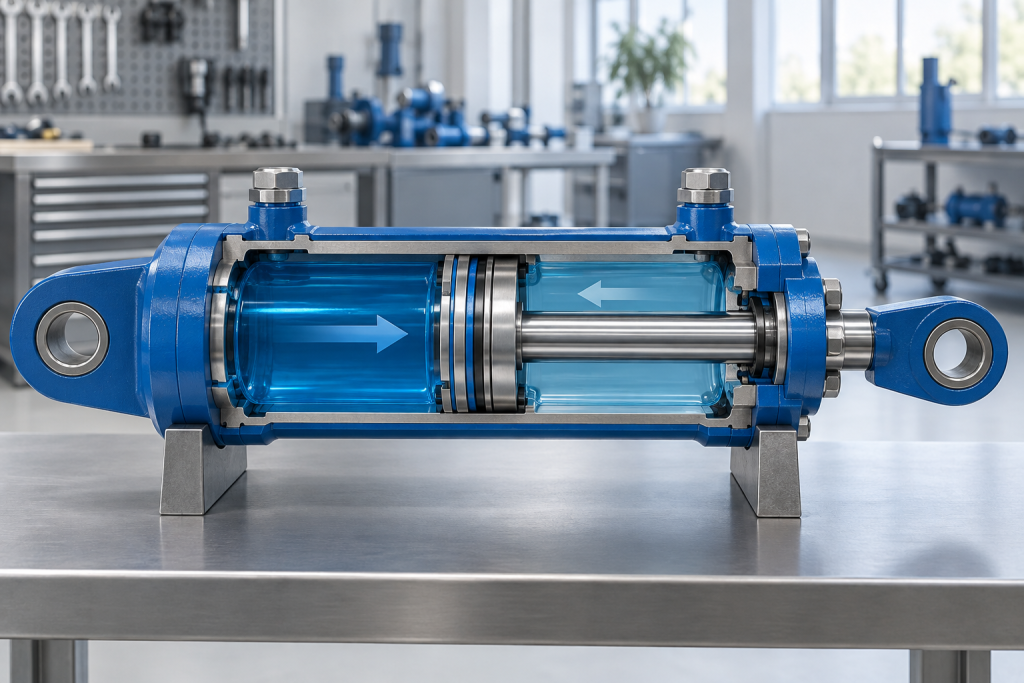
Hydraulic cylinder force depends on pressure acting over the correct effective area. The familiar relationship F = pA is a useful starting point, but a double-acting cylinder normally has pressure acting on both sides of the piston. Its net hydraulic force depends on both chamber pressures and both areas.
For a conventional single-rod cylinder, the cap side uses the full bore area, while the rod side uses the smaller annular area. That is why equal supply pressure usually produces different theoretical push and pull forces when the opposite chamber is near zero gauge pressure. Understanding the areas, pressure references, and units helps avoid mistakes before moving on to cylinder selection or interpreting machine performance.
目次
- Understand what F = pA describes
- Use consistent pressure, area, and force units
- Identify full-bore and annular areas
- Calculate theoretical push and pull force
- Include the pressure on the opposite side
- See why equal pressures need not balance
- Connect area to speed and energy
- Separate calculated force from an approved load rating
- よくある質問
Understand what F = pA describes
Pressure is force per unit area. Rearranging that relationship gives F = pA, where pressure acts uniformly over the effective area being considered. This describes one pressure-force contribution; it does not automatically describe the complete force balance of a cylinder.
Pascal's principle explains how an applied pressure change is transmitted through a confined fluid in static conditions. It does not mean every location in a working hydraulic circuit always has identical pressure. Height differences and flow through restrictions require additional consideration. OpenStax: Pascal's principle
A pump supplies flow by transferring mechanical energy to the fluid. Load resistance, circuit paths, and control devices influence the resulting pressures. For the movement sequence, see 油圧シリンダーの仕組み.

Use consistent pressure, area, and force units
Choose one compatible unit set before multiplying.
| Pressure and area | Force relationship |
|---|---|
| Pa and m² | F(N) = p(Pa) × A(m²) |
| MPa and mm² | F(N) = p(MPa) × A(mm²) |
| bar and mm² | F(N) = p(bar) × A(mm²) ÷ 10 |
| bar and cm² | F(N) = p(bar) × A(cm²) × 10 |
| psi and in² | F(lbf) = p(psi) × A(in²) |
One MPa equals one N/mm², and one bar equals 0.1 MPa. Convert N to kN by dividing by 1,000. Do not multiply a bar value by an area in mm² and label the unchanged number as newtons.
Mass is different from force. For an illustrative stationary mass of 1,000 kg, using g = 9.81 m/s² gives a weight of 9,810 N, or 9.81 kN. The cylinder force needed to move that mass also depends on direction, geometry, friction, and acceleration.
その hydraulic cylinder terminology guide helps distinguish working pressure, bore, rod diameter, and other related terms.
Identify full-bore and annular areas
For a conventional single-rod cylinder, define bore diameter D and rod diameter d:
- Cap-side area: Ac = πD²/4.
- Rod cross-sectional area: Ar = πd²/4.
- Rod-side annular area: Aa = Ac − Ar = π(D² − d²)/4.
Use the cylinder bore, not the outside diameter of the barrel. On the rod side, the rod occupies part of the piston cross-section, leaving an annular pressure area.
Parker's HMI guide distinguishes the full-area push side from the reduced-area pull side. It also explains why increasing rod size reduces available annular area. Parker HMI selection guide
These expressions apply to the stated geometry. Double-rod, telescopic, and other arrangements need their own area definitions. The hydraulic cylinder basics article provides the component context.

Calculate theoretical push and pull force
Consider an original example with D = 50 mm and d = 30 mm. Assume a supplied chamber pressure of 100 bar, the opposite chamber at zero gauge pressure, and no friction or other mechanical losses.
| 数量 | 計算 | Rounded result |
|---|---|---|
| Cap area | π × 50² / 4 | 1,963.495 mm² |
| Rod area | π × 30² / 4 | 706.858 mm² |
| Annular area | π × (50² − 30²) / 4 | 1,256.637 mm² |
| Extension force | 100 × Ac / 10 | 19.635 kN |
| Retraction force | 100 × Aa / 10 | 12.566 kN |
The ideal pull force is smaller because the pressure acts on the annular area. Here the pull-to-push ratio is Aa/Ac = 0.64 under the stated equal-supply-pressure conditions.
These values are calculated hydraulic forces, not a product rating or an approved lifting capacity. HAWE defines nominal cylinder force as a theoretical quantity that ignores friction losses. HAWE nominal force definition
Keep unrounded areas during calculation and round the final result consistently. Actual sizing also needs the checks in the hydraulic cylinder sizing guide.
Include the pressure on the opposite side
Let pc be cap-chamber pressure and pr be rod-chamber pressure, both expressed as gauge pressures relative to the same surrounding atmosphere. For the conventional piston-and-rod assembly, take extension as positive:
Fhyd = pc × Ac − pr × Aa
Use compatible units, including the conversion factor when pressures are in bar and areas in mm². This is the net hydraulic contribution. Friction, external load, and inertia belong in the complete mechanical force balance.
During extension in the example, let pc = 100 bar and pr = 10 bar. The rod-side pressure opposes extension:
Fhyd = (100 × 1,963.495 − 10 × 1,256.637) / 10
Fhyd ≈ 18,378 N = 18.378 kN.
For retraction, let pr = 100 bar and pc = 10 bar. Expressing the result as a retraction-force magnitude:
Fhyd,retract = (100 × 1,256.637 − 10 × 1,963.495) / 10
Fhyd,retract ≈ 10,603 N = 10.603 kN.
Do not simply multiply the difference between chamber pressures by one area. That shortcut misses the different effective areas in a single-rod cylinder. Use pressures at the relevant chambers; a pump gauge reading may include other circuit pressure differences.

See why equal pressures need not balance
If both chambers in the same example are at 50 bar gauge pressure, their hydraulic forces are unequal because their areas differ:
Fhyd = 50 × (Ac − Aa) / 10 = 50 × Ar / 10
Fhyd ≈ 3,534 N = 3.534 kN toward extension.
This is the hydraulic-force tendency only. Whether the piston moves depends on external load, friction, constraints, and the available flow paths. Equal pressure readings therefore do not, by themselves, prove balanced force or secure load holding.
A stopped cylinder also does not require its chamber pressures to be equal. Unequal pressure-area products can balance an external load. See hydraulic cylinder drift when evaluating unwanted motion rather than inferring condition from pressure alone.
Connect area to speed and energy
At unchanged pressure, doubling bore diameter multiplies the full-bore area and its ideal force contribution by four. Doubling area requires multiplying diameter by √2, not by two. These comparisons assume the geometry and other relevant conditions remain appropriate.
For approximately incompressible flow with leakage neglected, actuator speed follows v = Q/A using consistent units. At the same incoming flow, a larger supplied area moves more slowly. Increasing force capability by increasing area therefore changes the flow needed for a target speed.
Force multiplication does not create energy. In an ideal connected-piston illustration, equal displaced volumes give A1 × x1 = A2 × x2. The larger-area piston travels a shorter distance for the same transferred volume. Its greater force is balanced by reduced travel, so ideal work remains consistent. OpenStax hydraulic systems explanation
Real systems add losses. The hydraulic power unit must supply the required pressure-flow operating point within its ratings; area alone does not determine the available power.

Separate calculated force from an approved load rating
A useful calculation record identifies the geometry, chamber pressures, direction, unit system, and assumptions. Then assess how the theoretical hydraulic result relates to the actual mechanism.
Check friction and starting behavior, pressure losses, acceleration, rod strength and buckling, mounting and rod-end capacity, alignment, and component ratings. For a suspended load, the holding and lowering arrangement is an additional system requirement.
Do not apply an invented universal efficiency or safety factor to turn pA into an approved working load. The appropriate allowances and verification depend on the application and governing requirements.
「」を使用してください cylinder specification and RFQ checklist to record the inputs and unresolved items. An equation can establish a theoretical contribution while the equipment's permitted use remains subject to engineering approval.
よくある質問
Can one pressure gauge tell me the cylinder's output force?
Only under clearly justified assumptions about the other chamber, effective areas, losses, and the measurement location. Two chamber pressures are needed for the general hydraulic-force expression above.
Does a thicker rod increase pulling force?
At the same bore and rod-side pressure, it reduces annular area and ideal pulling force. Rod strength and pull-force requirements must be considered together.
Does high pressure mean the cylinder is moving quickly?
No. Speed depends primarily on the flow reaching the moving chamber and its effective area, with leakage and dynamic effects also relevant.
Can a cylinder produce force without moving?
Yes. Hydraulic force can balance an external load or act against a constraint. No visible movement does not mean no force or no stored pressure.
Record both chamber pressures, bore, rod diameter, and force direction before using the result in an application review.
関連記事
油圧シリンダーはどのように動作するのか? 伸長と収縮の仕組みをわかりやすく解説

油圧シリンダの用語:エンジニアと購買担当者にとって不可欠な用語

油圧シリンダとは? 定義、構成部品、および仕組み
油圧シリンダの選定方法:推力、内径、ロッド、ストローク、流量
この油圧に関する知識を応用する上で、お手伝いが必要ですか?
図面、写真、使用圧力、機器の詳細、または用途に関するご質問などをお送りください。.