Hydraulic Cylinders in Agricultural Machinery: Applications and Selection Points
Select hydraulic cylinders for agricultural machinery by checking motion, loads, tractor interfaces, mounting, contamination exposure, and transport requirements.

Hydraulic cylinders in agricultural machinery provide linear movement for lifting, folding, positioning, and adjusting implements. Their suitability depends on the complete machine task: load direction, linkage geometry, required stroke, available hydraulic supply, mounting, and exposure to field conditions. A cylinder that fits between two pins may still have unsuitable force, speed, rod support, or sealing characteristics.
Begin with the implement's movements and the tractor or onboard hydraulic interface. Then define the cylinder and its controls together, including what happens during transport, loss of power, and maintenance. This guide covers common implement functions and selection inputs. It does not approve steering or braking modifications, prescribe one pressure for all tractors, or replace the machine manufacturer's operating and service instructions.
Contents
- Match the cylinder to the agricultural function
- Translate machine loads and motion into requirements
- Confirm single-acting or double-acting behavior
- Check the tractor and implement hydraulic interface
- Design mounting and coordination for field movement
- Specify protection against the actual environment
- Plan transport, maintenance, and supplier verification
- Frequently asked questions
Match the cylinder to the agricultural function
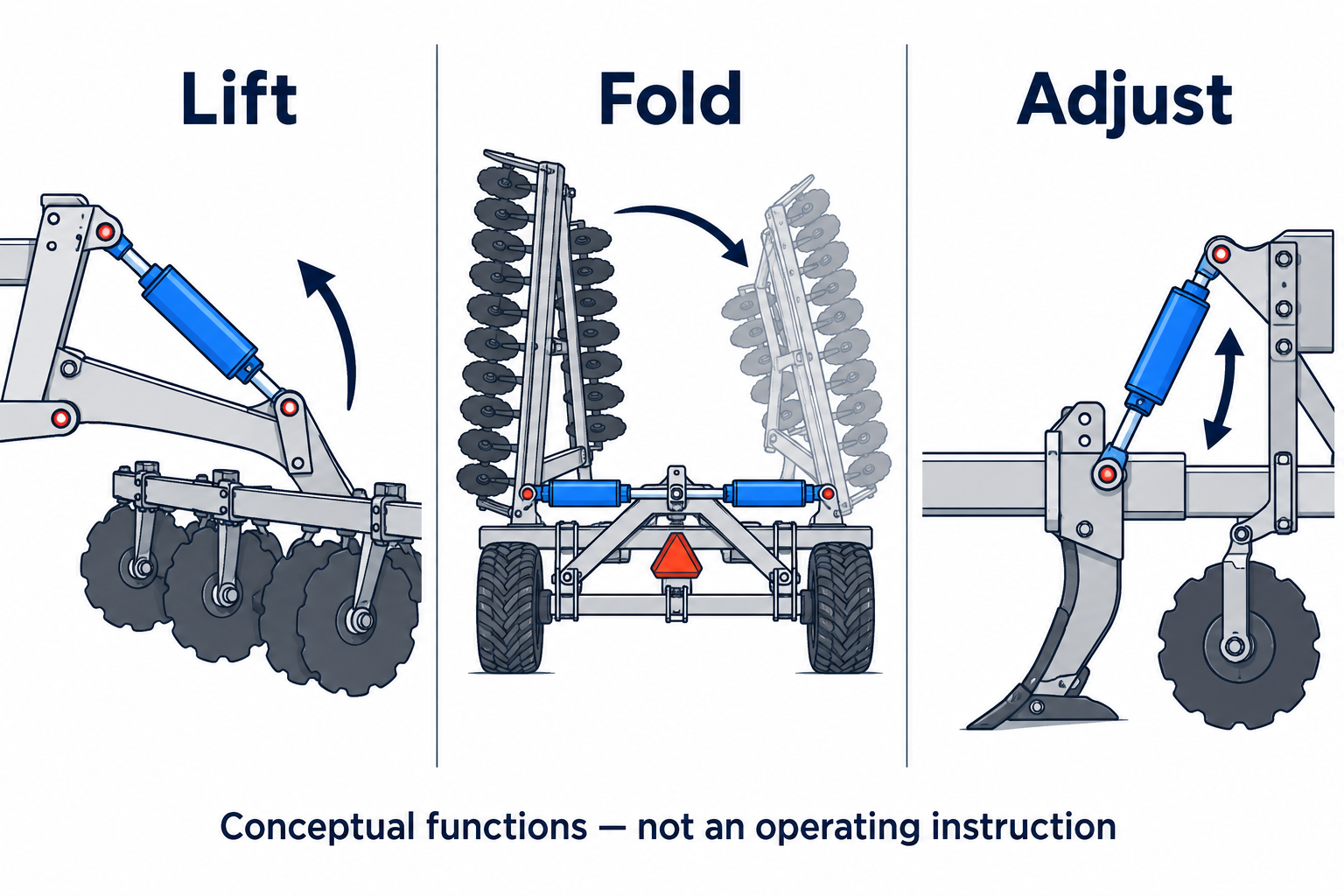
Agricultural machinery uses cylinders in tasks with very different load and motion patterns. Occasional folding, repeated lifting, and small positioning adjustments should not be treated as the same application simply because they use similar-looking cylinders.
| Function | Typical application context | Main selection questions |
|---|---|---|
| Lift or lower | Implement frames, support wheels, access structures | How do load and leverage change through travel? |
| Fold or unfold | Wing sections and transport-width mechanisms | What sequence, clearance, and transport restraint are required? |
| Adjust position | Working depth, angle, height, or machine settings | What position range and repeatability are needed? |
| Actuate a mechanism | Gates, latches, or controlled machine functions | What forces and end-position behavior occur? |
These examples describe functional categories, not verified designs for particular machines. Parker's planter application page includes hydraulic cylinders among the components used in agricultural implements, illustrating the need to integrate cylinders with the rest of the implement system. Parker planter application information.
Record the number of cycles and time spent in each state. A cylinder used infrequently for transport folding may still experience severe loads while the machine travels or works. A frequently adjusted cylinder may require different wear, control, and monitoring provisions.
The broader system context is covered in hydraulic systems for mobile equipment.
Translate machine loads and motion into requirements
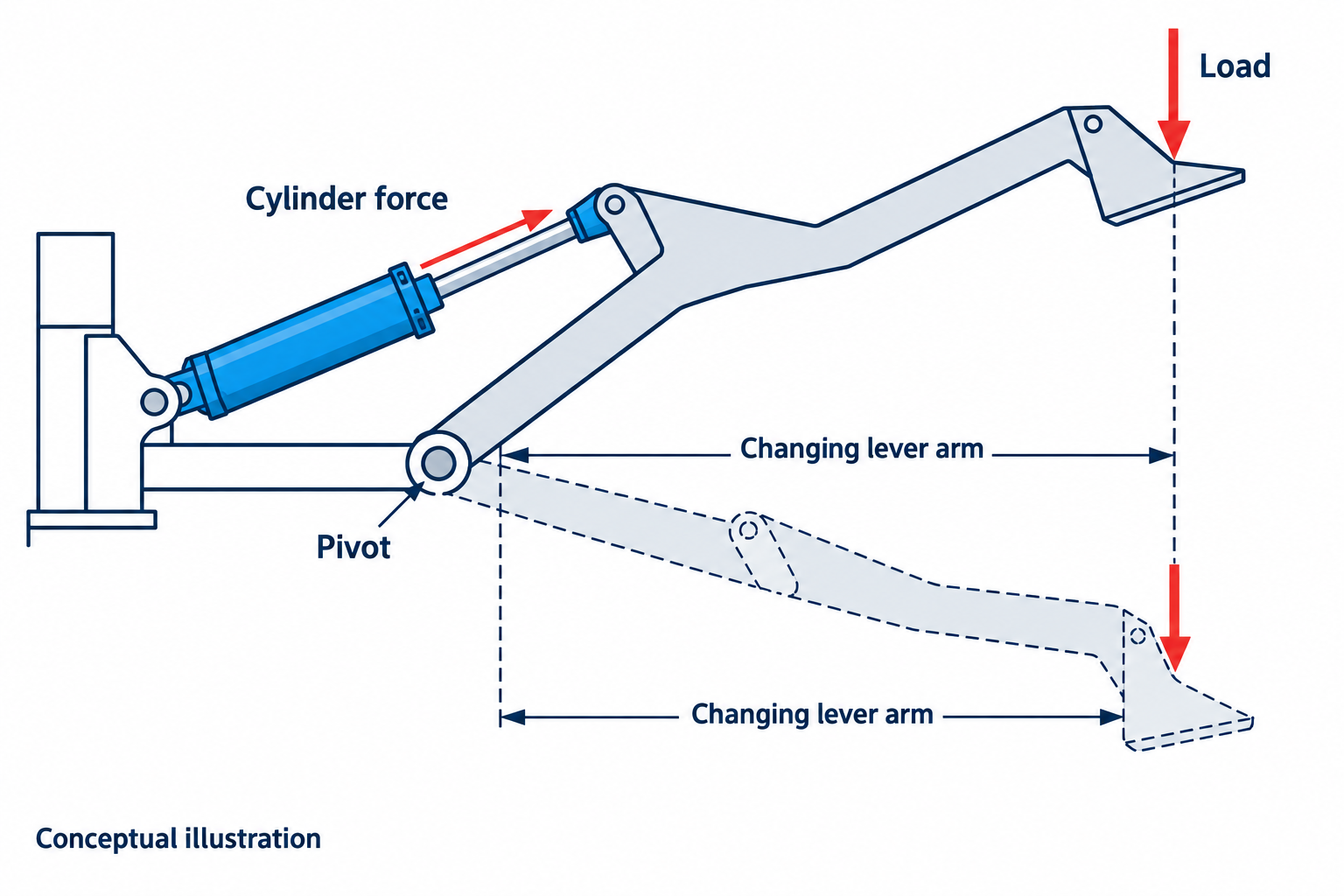
Do not use the implement's total mass as the cylinder load without examining the mechanism. Lever arms, cylinder angle, friction, slope, acceleration, and external resistance change the required force. Soil or crop interaction may introduce loads that are absent during an unloaded workshop demonstration.
Evaluate the full movement. A cylinder can have adequate force near one position and insufficient force where the effective moment arm becomes small. Identify whether it pushes, pulls, or must control a load that tends to drive the motion.
Stroke follows the change in mounting distance, not necessarily lift height or wing-tip movement. Check both retracted and extended mounting dimensions and the swept envelope. The method in choosing cylinder stroke length explains this distinction.
Specify speed and cycle requirements together with force. Increasing bore area may increase theoretical force at the same chamber pressure, but it also changes the flow required for a given speed and the volume exchanged with the supply.
Record uncertain loads as engineering inputs to resolve. A supplier can evaluate a defined load case; “heavy duty for farming” is not enough to establish structural or fatigue requirements. Use hydraulic cylinder sizing to organize the complete selection.
Confirm single-acting or double-acting behavior
A single-acting cylinder uses hydraulic power in one direction, with an external force such as gravity or a spring providing return in the intended design. That arrangement must return reliably through the required geometry and operating conditions.
A double-acting cylinder provides hydraulic actuation in both directions, but the available forces and flows differ between chambers in a single-rod design. It does not automatically solve every holding or lowering requirement.
Describe what should happen when the tractor control is neutral, power is lost, a movement is interrupted, or the machine is parked. The correct behavior depends on the complete circuit and mechanical arrangement.
Floating operation, where required by an implement, is a specific circuit function. It should not be assumed from a cylinder's construction or from the number of connected hoses.
Load-control valves, mechanical restraints, and controls must be selected for the actual machine. Do not convert a single-acting application to double acting, or the reverse, merely because a replacement cylinder is readily available.
Check the tractor and implement hydraulic interface
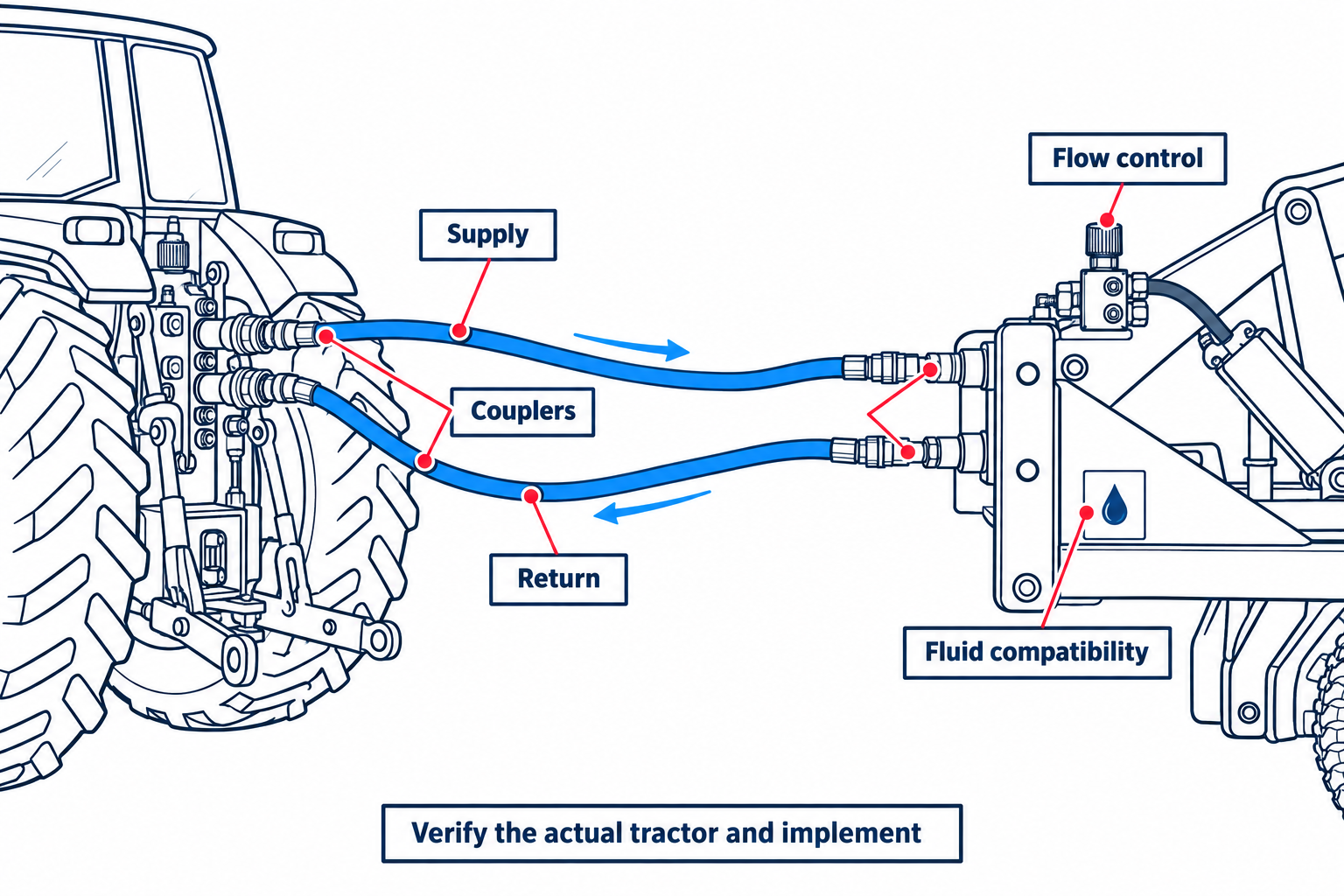
Confirm the supply available to the implement under its real operating conditions. Record pressure and flow together, flow-control capability, relevant valve modes, return restrictions, and the fluid specification. There is no single interface description that covers every tractor and implement combination.
Quick couplers need compatible connection types and appropriate performance for the duty. Physical connection alone does not establish suitable flow, pressure, contamination control, or intended direction.
John Deere's hose-connection instructions emphasize clean fittings and couplers and identification of cylinder movement direction. Those are useful interface principles; the actual connection and pressure-release procedure must come from the manuals for the specific tractor and implement. John Deere hydraulic hose information.
Consider the volume drawn from and returned to the shared hydraulic supply. Cylinder positions change reservoir inventory, and an implement containing residual oil may introduce a different fluid when connected to another tractor. Confirm compatibility rather than assuming all agricultural hydraulic oils can be mixed.
Return flow and backpressure deserve explicit checks. In a single-rod cylinder, one direction can produce a return flow different from the supply flow. A restrictive coupler or return route can affect movement and pressure conditions.
Identify hoses and functions clearly so the intended motion and valve connection can be verified during approved commissioning.
Design mounting and coordination for field movement
Cylinder mounts must permit the required articulation while transmitting the intended loads. Pins, bushings, brackets, rod ends, and frame stiffness form one mechanical load path. The cylinder should not be expected to correct a misaligned or inadequately guided mechanism.
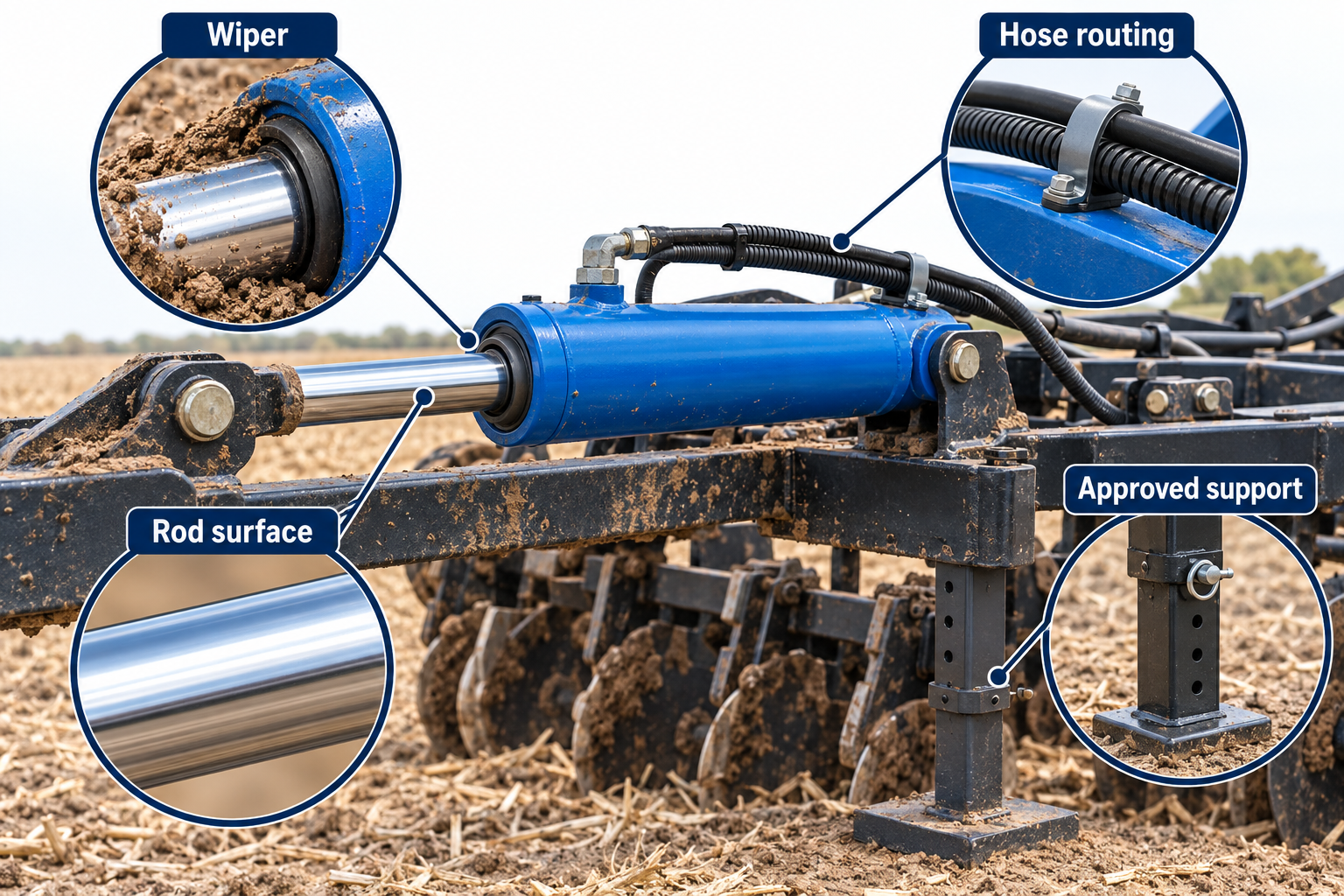
Check clearance through working, transport, and adjustment positions. Hoses must accommodate motion within their specified installation limits without being stretched, pinched, twisted, or exposed to avoidable abrasion.
Read the mounting drawing and tolerances together. Two cylinders with equal bore and stroke may have different retracted lengths, rod-end widths, pin sizes, port orientation, or articulation capability. Reading cylinder drawings helps prevent a dimensional match from being assumed too early.
Multiple cylinders connected in parallel do not automatically synchronize. Differences in load, friction, leakage, or geometry can make one move first. Series or rephasing arrangements also have specific design requirements and limitations. Where coordinated movement is required, define acceptable mismatch and the method for controlling or correcting it.
Evaluate what happens if one section stops while another continues. That condition may create frame loads or interference that a single-cylinder analysis misses. Coordination belongs to the implement system, not only the cylinder purchase.
Specify protection against the actual environment
Describe dust, mud, fertilizer, manure, moisture, washdown, temperature changes, and outdoor storage as actual exposure conditions. Avoid requesting a vague “corrosion-proof” cylinder without a defined service environment or acceptance requirement.
The rod surface, wiper, seals, coatings, and exposed connections have different roles. A wiper helps limit contamination entry, while rod-surface condition affects the sealing interface. Protection must remain compatible with the fluid, temperature, movement, and cleaning process.
Do not prescribe one seal material or coating life for all agricultural duties. Ask the supplier to justify the selected materials and protection for the documented conditions, including chemicals and cleaning agents where relevant.
Plan inspection access. A damaged rod surface or worn mounting can be difficult to identify if hidden behind a guard or packed with debris. Guards should protect vulnerable parts while preserving the access required by the machine design.
For seasonal storage, follow the manufacturer's instructions for cylinder position, corrosion protection, cleaning, and recommissioning. Parking with a rod retracted may reduce exposure in some arrangements, but it is not a universal instruction if it conflicts with the machine's stable, supported parking condition.
Plan transport, maintenance, and supplier verification
Define transport restraints and maintenance supports as machine requirements. Hydraulic position holding during normal operation is not the same as an approved mechanical transport lock or support for personnel working beneath raised equipment.
HSE's agricultural maintenance guidance calls for safe management of stored energy and mechanical measures to prevent hydraulically supported parts from descending during work beneath them. Apply the machine's designed support and isolation arrangements; do not rely only on trapped hydraulic pressure. HSE safe maintenance guidance.
A useful supplier package includes the following information:
| Requirement group | Information to provide |
|---|---|
| Function and sequence | Working, adjustment, transport, and parking movements |
| Loads and geometry | Force directions, motion path, guidance, and exceptional conditions |
| Cylinder dimensions | Bore, rod, stroke, mounting datums, ports, and envelope constraints |
| Hydraulic interface | Supply and return conditions, fluid, couplers, and control modes |
| Environment | Contamination, corrosion, cleaning, temperature, and storage |
| Machine protection | Load control, transport restraint, maintenance support, and fault behavior |
| Verification | Approved drawings, material confirmation, performance checks, and records |
Use the cylinder specification checklist to identify missing information before comparing quotations. Ask suppliers to state deviations rather than hiding assumptions within a nominally matching part number.
Verify the selected configuration under representative conditions through an approved test plan. Check motion, clearances, interfaces, and control behavior; separately complete structural, durability, and protective-function assessments as required. An unloaded extension and retraction does not establish complete suitability.
Frequently asked questions
Is a welded cylinder always the correct agricultural choice?
No. Construction style is only one consideration. Loads, mounting, serviceability, environment, and the machine design determine suitability.
Can I replace a cylinder using only bore and stroke?
No. Retracted length, rod size, mounting details, ports, pressure conditions, fluid compatibility, and required functions also need confirmation.
Will two identical cylinders move together automatically?
Not necessarily. Load and circuit differences can cause unequal motion. Required synchronization must be addressed by the system design.
Can hydraulic pressure alone support raised equipment during maintenance?
Do not rely on it as the sole support for personnel working beneath raised parts. Use the machine's approved mechanical supports and isolation procedures.
Related Articles
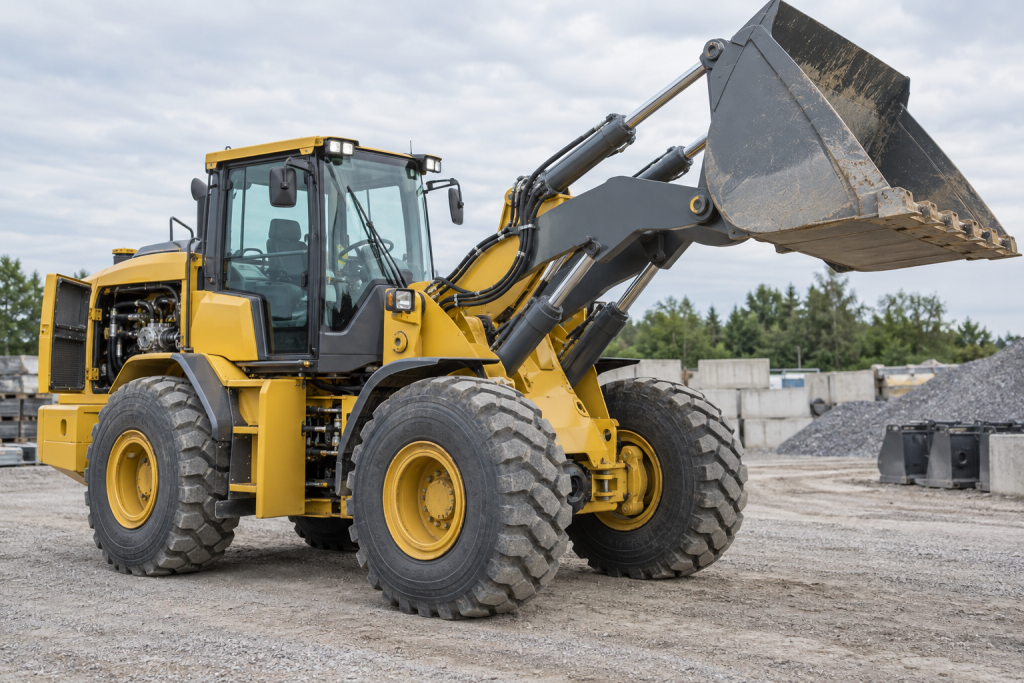
Hydraulic Systems for Mobile Equipment: Applications and Design Requirements

How to Choose Hydraulic Cylinder Stroke Length: Geometry and Fit
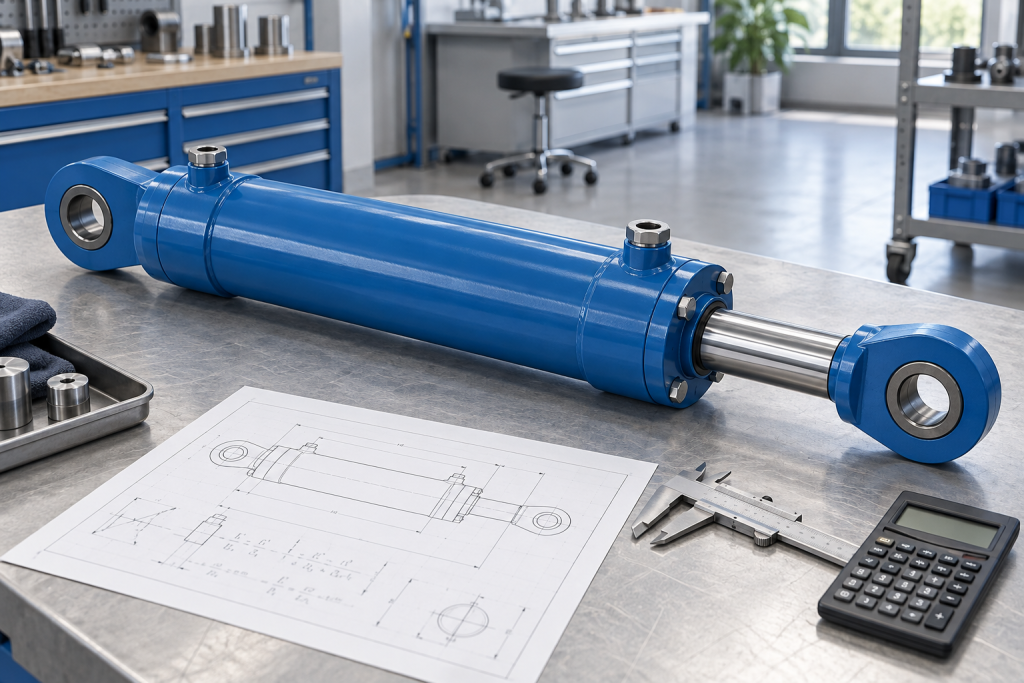
How to Size a Hydraulic Cylinder: Force, Bore, Rod, Stroke, and Flow

How to Read a Hydraulic Cylinder Drawing and Specification Sheet
Need help applying this hydraulic knowledge?
Send us your drawings, photos, operating pressure, equipment details, or application questions.