Hydraulic System Specification and RFQ Checklist: Scope, Interfaces, and Acceptance
Prepare a hydraulic system specification and RFQ checklist covering machine duty, component scope, interfaces, controls, documentation, and acceptance evidence.

A hydraulic system specification should describe what the machine must do, where the supplier's responsibility starts and ends, and how the result will be accepted. A pressure and flow requirement alone leaves too many questions unanswered. Two quotations can show the same nominal ratings while covering different actuators, controls, pipework, cooling arrangements, and commissioning work.
This checklist helps machine builders, project engineers, and purchasing teams assemble a common request for quotation, or RFQ. It covers functional requirements, interfaces, documentation, and acceptance evidence. Use it to expose missing decisions before comparing proposals. Unknown values can remain open during an early feasibility enquiry, provided their owners and consequences are visible. The checklist organizes engineering work; it does not replace application calculations or the machine's risk assessment.
Sommaire
- State what is being purchased and what remains outside
- Describe each axis and the complete operating sequence
- Specify operating points and simultaneous demand
- Define mechanical, hydraulic, and utility interfaces
- Include fluid, environment, and maintenance conditions
- Allocate control and risk-reduction responsibilities
- Request drawings, software, and lifecycle information
- Define acceptance before comparing quotations
- Use the RFQ checklist and deviation register
- Foire aux questions
State what is being purchased and what remains outside
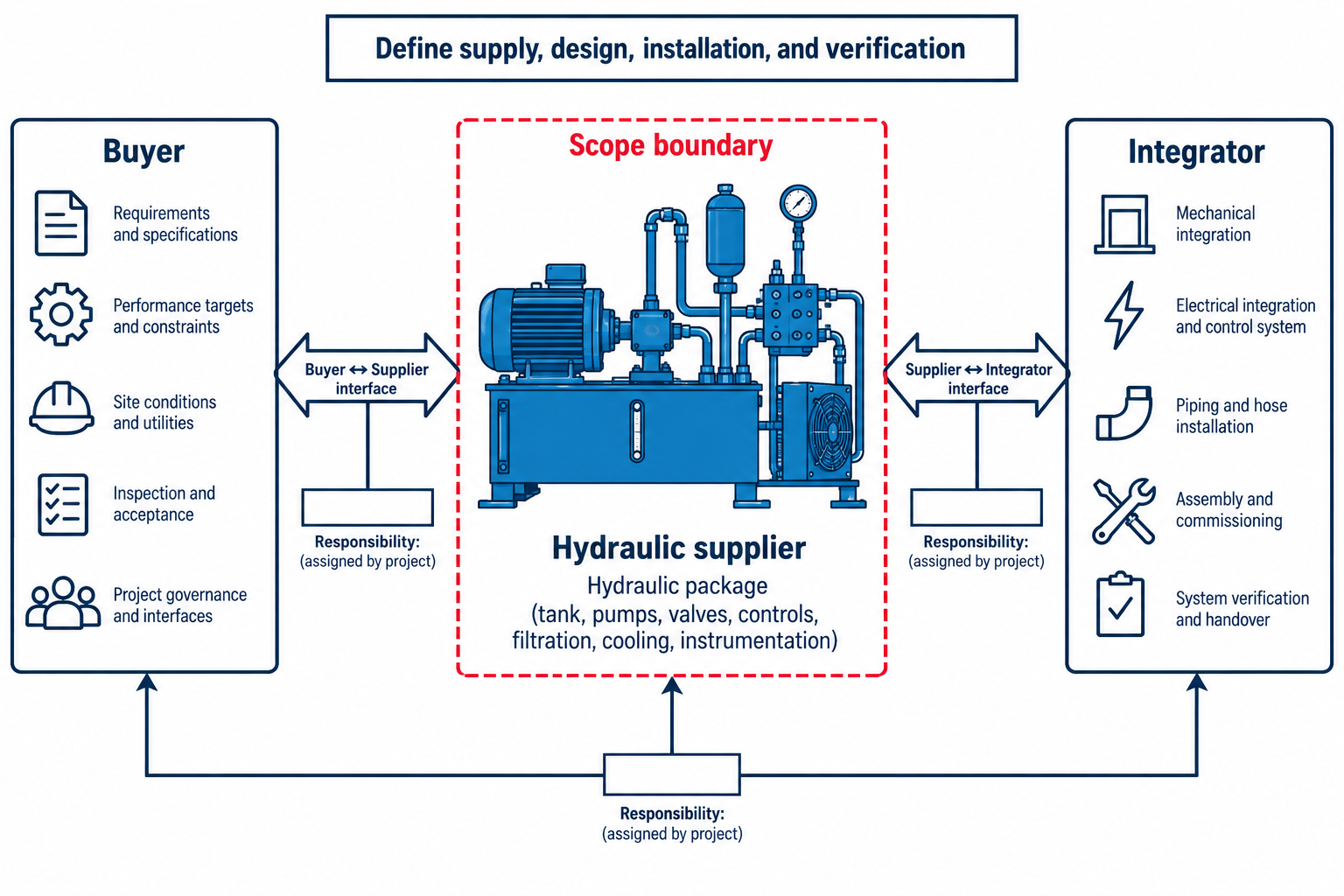
Start with the purchasing boundary. Are you buying a power unit, a hydraulic package including actuators, or an integrated machine subsystem with controls and installation? Give the package a name and list the included equipment. Draw its boundary on a simple block diagram, with every crossing assigned to an owner.
A useful scope schedule identifies supply, design, installation, and verification separately:
| Item | Questions to settle in the RFQ |
|---|---|
| Power unit and manifold | Who selects components, assembles them, and verifies performance? |
| Cylinders or motors | Who confirms loads, mountings, motion requirements, and compatibility? |
| External hoses and pipes | Who designs routing, supplies connections, installs, and cleans them? |
| Electrical controls | Who supplies the cabinet, programming, field wiring, and machine integration? |
| Structure and protection | Who designs supports, access, guarding, and machine protective functions? |
| Utilities and commissioning | Who provides electricity, cooling, oil filling, and site support? |
Do not treat an unlisted item as implicitly included. Ask suppliers to identify exclusions and dependencies. Distinguish a budget proposal based on assumptions from a production quotation based on released requirements. The power unit specification and RFQ checklist can support that individual supply package without defining the whole machine.
Describe each axis and the complete operating sequence
For each hydraulic axis, state the task, direction of movement, required travel, installation orientation, and connection to the load. Describe load variation over travel, external forces, acceleration needs, and whether the load can drive the actuator. Identify the information already measured and the information still estimated.
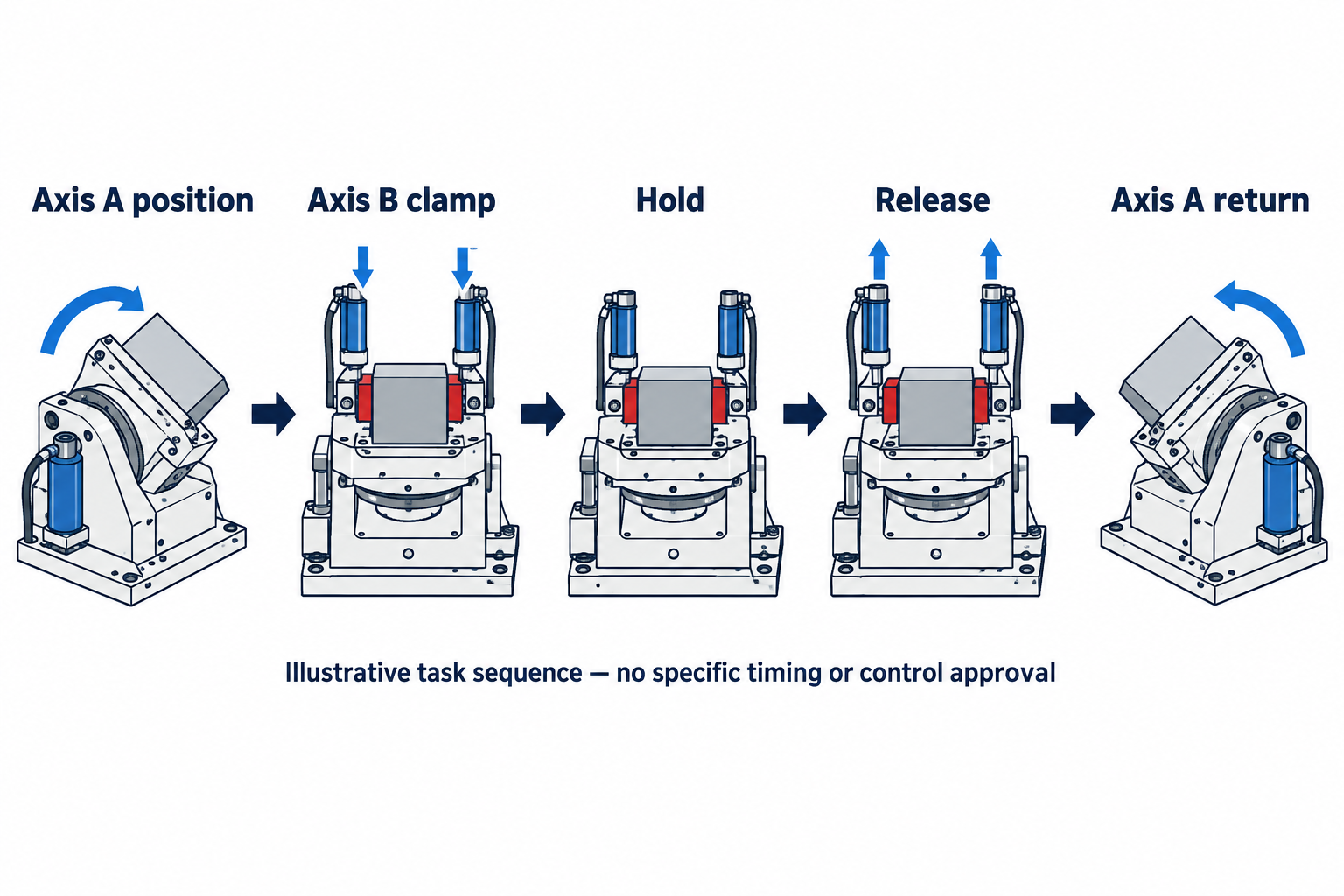
Give the sequence, not just a list of components. Include movement, dwell, pressure holding, release, stopping, and restart conditions. Explain which axes may operate together and which must wait for another action. Specify how frequently the sequence repeats and whether operation is intermittent or continuous during a shift.
Consider an original, hypothetical two-axis fixture. Axis A positions a workpiece; axis B clamps it; the process runs during a holding stage; B releases; A returns. This describes a task, not an approved control sequence. The designer still needs the forces, speeds, position criteria, permitted overlap, and assessed response to lost power or feedback. A diagram that merely says “clamp then process” does not establish safe permission to start the process.
Utilisation basic hydraulic system design to turn this functional description into a proposed circuit and component requirements.
Specify operating points and simultaneous demand
Provide operating conditions as a set of related points. State which pressure, flow, speed, and load occur together, how long each condition lasts, and what changes during transitions. Avoid presenting independent maximum values as though they necessarily occur at the same time.
Separate machine requirements from preliminary component selections. “Move this load through this travel within this time” is a functional need. A proposed cylinder diameter or pump displacement is a possible design response, unless an existing interface makes it mandatory. Mark such constraints explicitly so suppliers know where alternatives are welcome.
For every numerical input, record units, location, operating state, source, and confidence. A force at the workpiece is different from an axial force at the cylinder rod. Likewise, a required actuator pressure is not automatically the necessary pump outlet pressure after circuit losses.
Identify combinations of axes that determine peak demand and repeated conditions that determine heat generation. Include holding and idle stages rather than sizing only for the fastest movement. Ask suppliers to explain their assumptions about leakage, losses, motor loading, and thermal balance. The matching pump, valve, and cylinder guide provides the calculation context for these interacting requirements.
Define mechanical, hydraulic, and utility interfaces
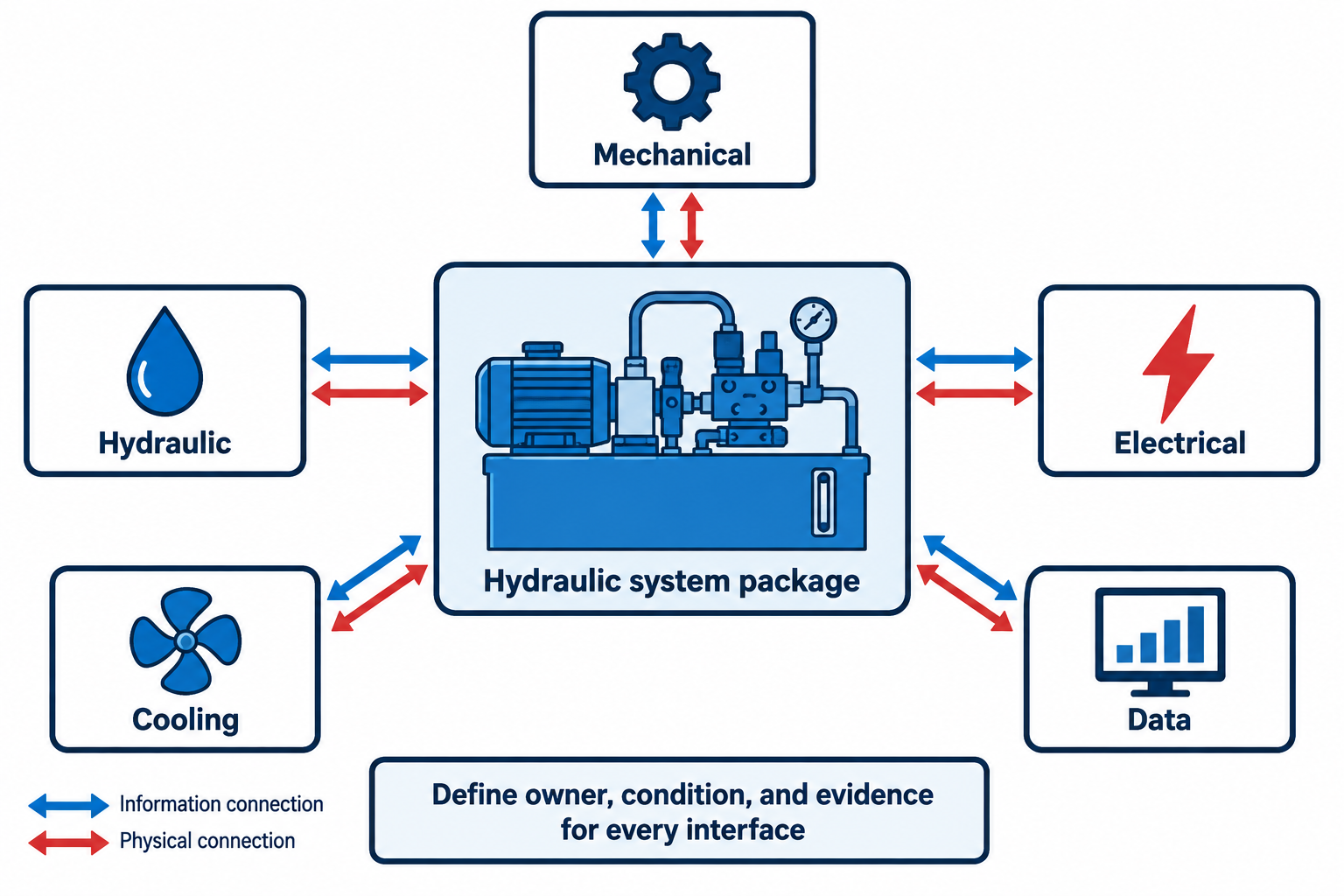
An interface schedule prevents individually suitable assemblies from becoming an unsuitable installation. Use drawings with stated datums and revisions for mounting points, envelope limits, service access, and connection locations. Distinguish a fixed customer interface from a preferred arrangement that the supplier may change.
| Interface | Information to exchange |
|---|---|
| Mechanical | Mounting datums, available space, orientation, mass constraints, lifting and service access |
| Hydraulic | Port identity, connection specification, operating envelope, routing responsibility, cleanliness requirements |
| Electrical | Available supply, permitted loading, cabinet boundary, wiring and connector responsibilities |
| Refroidissement | Available medium, inlet conditions, supply variation, connection and disposal responsibilities |
| Control and data | Signals, communication interfaces, command ownership, feedback, alarms, version compatibility |
Label pressure supply, return, case drain, pilot, and any other connections separately. They can have different allowable conditions and must not be treated as interchangeable. Confirm who checks backpressure, pressure losses, and hose movement at the installed machine.
Utilisez le Liste de contrôle des caractéristiques techniques des cylindres for actuator interfaces. When space or alignment is uncertain, request an interface review before release. A supplier's preliminary layout should carry its assumptions, rather than becoming an approved drawing simply because it accompanies a quotation.
Include fluid, environment, and maintenance conditions
Specify the intended fluid or the process for approving it. Include the required operating temperature and viscosity conditions, material compatibility, and any restrictions imposed by existing equipment. Let the selected components and application determine the cleanliness requirement; do not insert a universal cleanliness code without a supporting assessment.
Describe ambient conditions, dust, water exposure, corrosion concerns, altitude where relevant, and access for maintenance. State whether the machine works indoors, outdoors, in a mobile installation, or in another defined environment. Describe the duty profile that the supplier should use for cooling selection, along with available cooling utilities and their variations.
Ask how the proposed design supports inspection, sampling, filter replacement, oil changes, fault identification, and isolation for service. Identify who supplies initial fill, flushing equipment, consumables, and waste handling. If maintainers cannot reach a filter without dismantling adjacent equipment, a compact layout may create avoidable lifecycle cost.
Reservoir volume is one part of this discussion. The hydraulic oil tank sizing guide explains why a single volume rule cannot settle the system's thermal and fluid-management requirements.
Allocate control and risk-reduction responsibilities
State who defines the operating modes, issues commands, processes feedback, and integrates the hydraulic package with the machine controller. Describe requested behavior during normal stop, emergency situations, loss of electrical power, loss of hydraulic pressure, sensor faults, and recovery. The appropriate response depends on the machine and its hazards.
Assign ownership for the risk assessment, selection of protective measures, implementation, and validation. A hydraulic supplier may contribute essential information without controlling the whole machine. Equally, a machine integrator needs explicit evidence for functions allocated to the hydraulic package.
The public scope of ISO 4413 concerns general rules and safety requirements for hydraulic systems and components. ISO 12100 addresses machinery risk assessment and risk reduction. These scope descriptions help organize responsibilities; they do not establish compliance with unread clauses. Confirm applicable requirements and editions for the actual project.
Do not assign a safety performance level from an RFQ template. Require the responsible specialists to define and verify the necessary functions. The main hydraulic system components overview helps identify component boundaries, but component names alone do not establish protective performance.
Request drawings, software, and lifecycle information
List deliverables with their format, revision stage, owner, and due date. Typical requests include hydraulic schematics, component lists, assembly and interface drawings, port schedules, electrical drawings, settings records, operating instructions, maintenance instructions, and recommended spare parts. Decide which documents must be approved before manufacture and which must describe the final supplied configuration.
For programmed equipment, define the software version record, backup method, configuration files, diagnostic access, and recovery instructions. Specify licensing and access rights by agreement. Source code, engineering tools, and modification rights should not be assumed to accompany a control package automatically.
Ask how changes will be documented between quotation, design review, factory testing, and site commissioning. A late component substitution can affect mounting, fluid compatibility, controls, maintenance stock, and acceptance evidence. Require an agreed review process for such changes.
Arrange document delivery so the machine owner can maintain the equipment after handover. A component list without exact identification or a manual that describes an earlier circuit revision may be inadequate even when all promised file names have been supplied. Include training and the language of instructions where these matter to the operating team.
Define acceptance before comparing quotations
Map each important requirement to a verification method, responsible person, operating condition, and acceptance rule. Separate document review, dimensional checks, functional tests, performance measurements, thermal evaluation, and verification of protective functions. One successful motion cycle cannot demonstrate every requirement.
Define the factory acceptance test, or FAT, and site acceptance test, or SAT, according to available equipment and installation dependencies. A factory can check the supplied package under agreed simulated conditions, while final pipework, site utilities, and integrated machine behavior may require site verification. Record what each stage can and cannot establish.
For measured quantities, agree the measurement locations, instrument suitability, calibration evidence, uncertainty treatment, and decision rule near a limit. NIST's traceability guidance explains why metrological traceability concerns measurement results and their calibration chain; a label alone does not establish fitness for a particular acceptance decision.
Pressure testing requires a planned procedure and suitable safeguards. HSE GS4 provides guidance on controlling pressure-testing hazards. Do not invent a universal test-pressure multiplier or holding time for the RFQ.
Le Liste de contrôle pour la réception du banc d'essai offers a useful evidence structure. Adapt it to the purchased hydraulic system; test-bench acceptance criteria are not automatically system acceptance criteria.
Use the RFQ checklist and deviation register
Issue a controlled checklist with space for the buyer's requirement, supplier response, supporting evidence, and unresolved action. The following headings can form a working RFQ register:
| RFQ heading | Buyer input | Required supplier response |
|---|---|---|
| Scope | Included packages and responsibility boundaries | Included, excluded, and dependent items |
| Axis duties | Loads, travel, orientation, speed, dwell | Proposed approach and missing data |
| Sequence | Operating stages and permitted overlap | Demand assumptions and proposed sequencing interfaces |
| Operating envelope | Related minimum, normal, and maximum conditions | Rated capability and stated limitations |
| Interfaces | Drawings, ports, electricity, cooling, data | Connection schedule and interface deviations |
| Fluid and environment | Intended fluid and service conditions | Compatibility and environmental limitations |
| Controls | Modes, signals, fault behavior, integration owner | Control scope and validation responsibilities |
| Maintenance | Access, isolation, consumables, service expectations | Service provisions and required customer support |
| Documentation | Drawing, software, manual, and spare-parts requirements | Deliverable list and revision milestones |
| Acceptance | Conditions, methods, decision rules, records | Proposed verification and exclusions |
| Delivery and support | Installation, commissioning, training requirements | Included services and prerequisites |
| Open decisions | Unknown input, owner, and target date | Effect on design, price basis, and schedule |
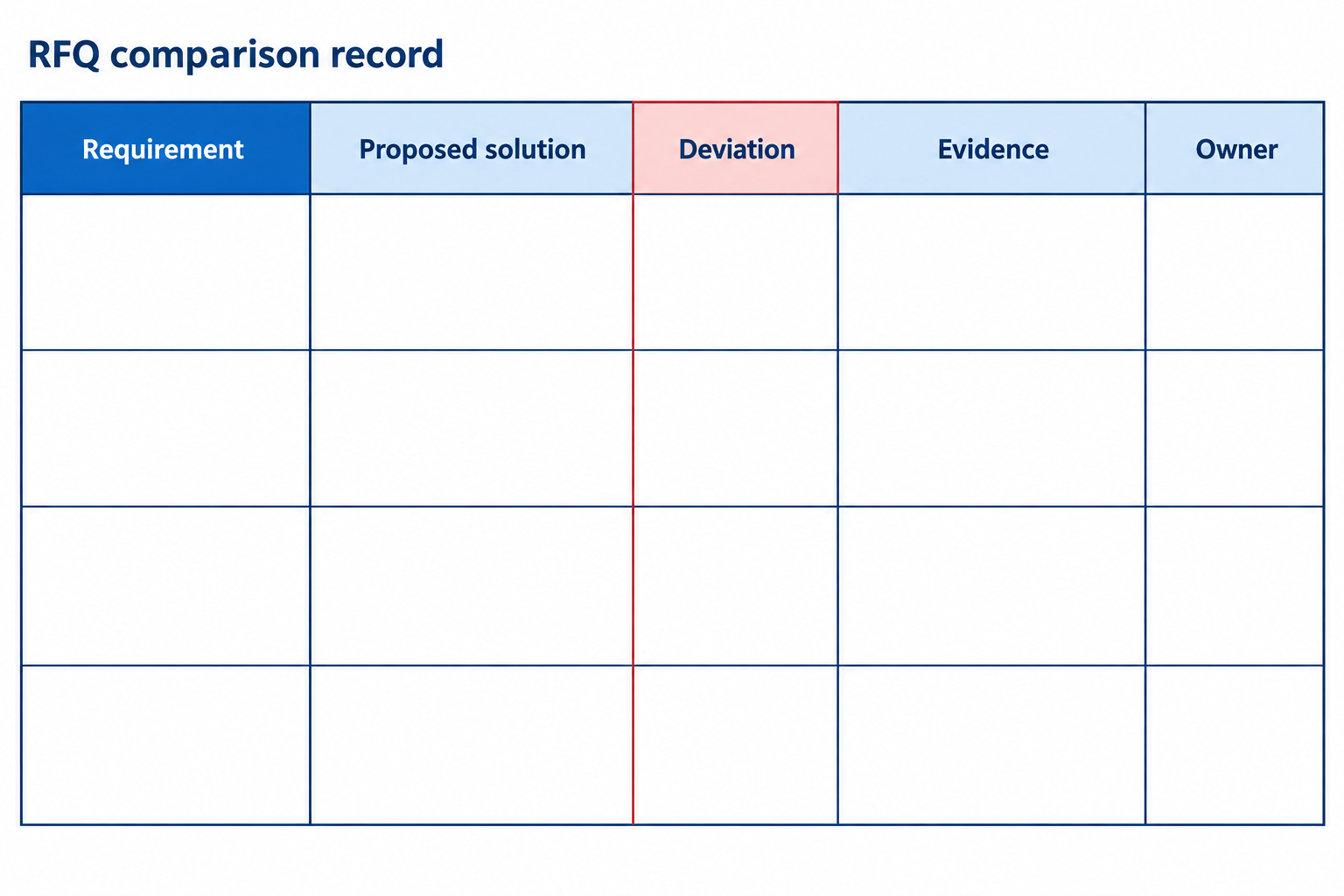
Mark each technical requirement as complied with, partly met, excluded, or requiring clarification. Keep optional improvements separate from the base proposal. A deviation register should identify the requirement, offered solution, difference, consequence, evidence, and decision owner.
Compare proposals only after these differences are understood. A lower quoted price may cover a narrower package or rely on customer-provided equipment and testing. Request clarification against the same requirement revision, then record accepted changes before releasing the order.
Keep unresolved assumptions visible through design review. If an estimated load, duty cycle, cooling condition, or installation dimension changes, obtain confirmation of the resulting design and commercial effects. An RFQ is a controlled input to engineering, not a one-time form that makes subsequent changes disappear.
Foire aux questions
Can we send an RFQ before all component sizes are known? Yes. State the machine's functional requirements and identify which engineering selections belong to the supplier. Unknown loads or operating conditions need a named owner and resolution date; they should not silently become guaranteed design inputs.
Are pressure and flow enough to compare systems? No. Related operating points, duration, simultaneous demand, scope, interfaces, control behavior, documentation, and verification can all change the offered solution.
Does buying a hydraulic package transfer all machine-safety responsibility? The RFQ should explicitly allocate assessment, design, integration, and validation responsibilities. A supply package does not by itself resolve responsibilities across the complete machine.
Should we choose the lowest quotation? First compare equivalent scope and evidence. Review deviations, operating limitations, maintenance provisions, integration work, and acceptance obligations alongside price and schedule. Freeze the common requirements before making that comparison.
Articles connexes

Hydraulic Power Unit Specification and RFQ Checklist

Comment concevoir un système hydraulique de base : spécifications, circuit et vérifications

Comment choisir une pompe, une vanne et un vérin hydrauliques pour former un système

Spécifications des vérins hydrauliques et liste de contrôle pour les demandes de devis
Vous avez besoin d'aide pour mettre en pratique ces connaissances en hydraulique ?
Envoyez-nous vos schémas, vos photos, la pression de service, les caractéristiques de votre équipement ou vos questions concernant l'application.