유압 실린더와 공압 실린더: 주요 차이점 및 선택 방법
Compare hydraulic and pneumatic cylinders by working fluid, force, speed, control, maintenance and total system cost to choose a suitable motion technology.

A 유압 실린더 uses pressurized hydraulic oil to create linear force and motion. A pneumatic cylinder uses compressed air to create linear movement. Both cylinders can extend and retract, but they are not designed for the same applications.
The simplest difference is this:
Hydraulic cylinder = oil + high force + heavy-duty applications

Pneumatic cylinder = air + fast movement + light-duty automation
A hydraulic cylinder is usually selected when a machine needs high force, stable load holding, and heavy-duty performance. A pneumatic cylinder is usually selected when the application needs fast, clean, simple, and lower-force motion.
This article explains the key differences between hydraulic cylinders and pneumatic cylinders, including working medium, force, speed, control, cleanliness, cost, maintenance, and typical applications.
목차
- 간단한 답변
- 유압 실린더란 무엇인가요?
- What Is a Pneumatic Cylinder?
- Main Difference: Hydraulic Oil vs Compressed Air
- 힘의 비교
- Speed Comparison
- Control and Stability
- Cleanliness and Working Environment
- Cost and Maintenance
- 애플리케이션 비교
- Can a Pneumatic Cylinder Replace a Hydraulic Cylinder?
- How to Choose Between Hydraulic and Pneumatic Cylinders
- 흔히 저지르는 실수
- 실무적인 공학적 고려 사항
- Compare the Complete System
- 요약
- 자주 묻는 질문
- 기술 관련 참고 자료 및 읽을거리
- 관련 기사
간단한 답변
A hydraulic cylinder and a pneumatic cylinder are both linear actuators. They both convert fluid power into straight-line motion.
The main difference is the working medium.
유압 실린더는 유압 오일을 사용합니다. 공압 실린더는 압축 공기를 사용합니다.
The different working fluids influence compressibility, control, system layout, maintenance and leakage considerations. Compare each complete system against the same load and motion requirement.
In practical terms:
| 항목 | 유압 실린더 | 공압 실린더 |
|---|---|---|
| 작동 매체 | 유압유 | 압축 공기 |
| Typical strength | High force | Lower to medium force |
| Motion speed | Controlled, strong | Fast and simple |
| Load holding | Better for heavy loads | More difficult due to air compressibility |
| Cleanliness | Risk of oil leakage | Cleaner in many light-duty applications |
| System complexity | Higher | Usually simpler |
| 일반적인 용도 | Heavy machinery, lifting, pressing | Automation, packaging, light clamping |

유압 실린더란 무엇인가요?
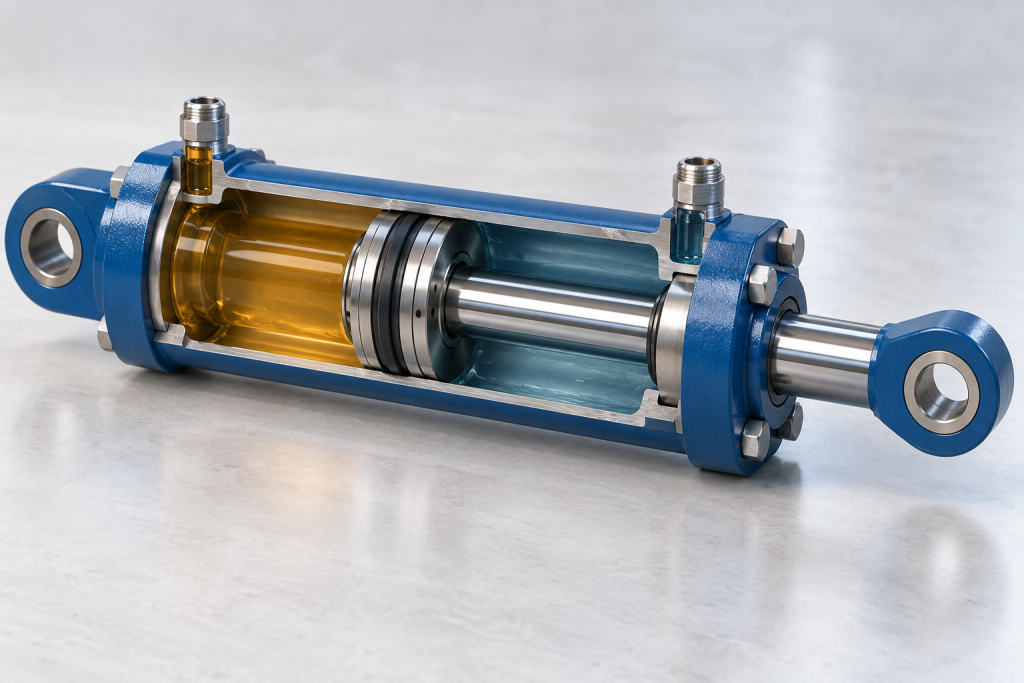
A hydraulic cylinder is a linear actuator that uses pressurized hydraulic oil to move a piston and piston rod.
When hydraulic oil enters one side of the cylinder, pressure acts on the piston area. This pushes the piston inside the cylinder barrel and moves the piston rod. The rod then transfers force to the machine.
Hydraulic cylinders are widely used when machines need strong pushing, pulling, lifting, lowering, tilting, or pressing force.
일반적인 용도로는 다음과 같은 것들이 있습니다:
- 굴착기
- 로더
- 농업용 기계
- 지게차
- 덤프 트레일러
- 테일 리프트
- Press machines
- 리프팅 플랫폼
- Marine equipment
- 산업용 기계
A hydraulic cylinder is usually chosen when the application requires high force, stable movement under load, or heavy-duty operation.
What Is a Pneumatic Cylinder?
A pneumatic cylinder is a linear actuator that uses compressed air to move a piston and rod.
Compressed air enters the cylinder through an air port. The air pressure acts on the piston and moves the piston rod. Like hydraulic cylinders, pneumatic cylinders can be single-acting or double-acting.
SMC describes pneumatic piston rod cylinders as components used to provide straight-line in/out linear movement, and notes that they are available in single-acting and double-acting styles. In a single-acting pneumatic cylinder, thrust is developed in one direction with spring return; in a double-acting pneumatic cylinder, air pressure is alternately applied to provide force in both directions.
Pneumatic cylinders are common in:
- Factory automation
- Packaging machines
- Sorting equipment
- Light clamping
- Pick-and-place equipment
- Small pushers
- Conveyor systems
- Clean production areas
They are often selected when the required force is not very high, but the motion needs to be fast, simple, and clean.
Main Difference: Hydraulic Oil vs Compressed Air
The biggest difference between hydraulic and pneumatic cylinders is the working medium.
A hydraulic cylinder uses oil.
A pneumatic cylinder uses air.
Hydraulic oil is much less compressible than air. This allows hydraulic cylinders to transmit force more effectively and maintain better control under heavy loads.
Compressed air is much more compressible. This makes pneumatic systems fast and flexible, but also makes load holding and very smooth low-speed control more difficult in many applications.
This does not mean pneumatic cylinders are poor products. It means they are designed for a different job.
If the job is light, fast, repetitive, and clean, a pneumatic cylinder may be the better choice.
If the job is heavy, force-demanding, or needs stable load control, a hydraulic cylinder is usually more suitable.

힘의 비교
Hydraulic cylinders usually provide much higher force than pneumatic cylinders of similar size.
The common force advantage of a similarly sized hydraulic cylinder normally comes from its higher operating pressure. At the same effective areas and chamber pressures, the ideal pressure-area force relationship is the same; using oil does not independently multiply force.
The basic force idea is similar for both hydraulic and pneumatic cylinders:
힘 = 압력 × 면적
However, hydraulic systems usually operate at much higher pressure than typical compressed air systems. That means a hydraulic cylinder can often generate much more force from a compact size.
This is why a hydraulic cylinder is commonly used for:
- Lifting a heavy boom
- Tilting a dump trailer
- Pressing material
- Moving heavy agricultural equipment
- Operating heavy-duty machinery
A pneumatic cylinder is more commonly used for:
- Moving a small gate
- Pushing a light part
- Clamping a small workpiece
- Moving a packaging component
- Operating automation devices
When selecting a cylinder, do not look only at stroke length. Force requirement is one of the most important selection factors.
Speed Comparison
Pneumatic cylinders are often faster and simpler for light-duty movement.
Compressed air can be supplied quickly, and pneumatic circuits can be simple and responsive. This makes pneumatic cylinders popular in automation equipment where the motion is repetitive and the load is relatively light.
Hydraulic cylinders can also move fast, but their speed depends on oil flow, cylinder bore, valve size, hose size, load, and system design.
In simple terms:
Pressure mainly affects force.

Flow mainly affects speed.
For a hydraulic cylinder, increasing speed often means increasing pump flow or optimizing the hydraulic circuit. For a pneumatic cylinder, speed can often be adjusted with flow control valves, exhaust controls, and cushioning devices.
However, speed alone does not decide the best cylinder type. A cylinder that moves quickly but cannot safely handle the load is not suitable.
Control and Stability
Hydraulic cylinders usually provide better control and stability under heavy load.
Because hydraulic oil is much less compressible than air, a hydraulic cylinder can hold and move heavy loads more steadily. This is important in applications such as lifting equipment, machine arms, presses, and heavy-duty outdoor machinery.
Pneumatic cylinders can be very effective for fast and repetitive motion, but air compressibility can make precise low-speed movement and stable load holding more difficult.
For example:
- A pneumatic cylinder may be excellent for pushing a light product on a packaging line.
- A hydraulic cylinder is usually better for holding a heavy machine arm under load.
- A pneumatic cylinder may be suitable for fast clamping of a small part.
- A hydraulic cylinder is usually better for pressing or lifting heavy objects.
SMC also notes that some pneumatic specialty cylinders are designed for smoother speed, acceleration, and deceleration in demanding applications, which shows that motion control is possible in pneumatic systems but requires proper product and circuit selection.
Cleanliness and Working Environment
Pneumatic cylinders are often cleaner because they use compressed air instead of hydraulic oil.
This makes them suitable for many light-duty automation applications, especially where oil leakage would be a problem. Examples include packaging, assembly, sorting, and some clean production environments.
Hydraulic systems use oil, so leakage control is important. A leaking hydraulic cylinder can create contamination, maintenance issues, and safety risks.
However, hydraulic cylinders are often better for harsh outdoor and heavy-duty environments. Construction machinery, agricultural machines, dump trailers, marine equipment, and lifting systems often require the force and durability that hydraulic cylinders can provide.
So the choice is not simply “clean” versus “dirty.” It depends on the real working condition.
Choose pneumatic cylinders when cleanliness, speed, simplicity, and light-duty motion are the main requirements.
Choose hydraulic cylinders when high force, durability, load holding, and heavy-duty operation are more important.
Cost and Maintenance
Pneumatic cylinders are often simpler and lower cost at the cylinder level.
A basic pneumatic system may include an air compressor, filter, regulator, lubricator, valves, tubes, and cylinders. For factories that already have compressed air, adding pneumatic cylinders can be convenient and economical.
Hydraulic systems are usually more complex. They may include a hydraulic power unit, pump, oil tank, valves, filters, hoses, fittings, seals, and cylinders.
Hydraulic systems also require oil maintenance, filtration, seal inspection, leakage control, and pressure safety management. ISO 4413 covers general rules and safety requirements for hydraulic fluid power systems and components used on machinery, while ISO 4414 covers pneumatic systems and components.
However, cost should not be judged only by the price of the cylinder.
If the application needs high force, a pneumatic cylinder may need a much larger size or may not be suitable at all. In that case, the hydraulic solution may be the correct and safer choice.
애플리케이션 비교
| 신청 | Typical Starting Point | Reason to Investigate |
|---|---|---|
| Excavator boom | 유압 실린더 | High force and heavy load |
| Dump trailer lifting | 유압 실린더 | Long stroke and high lifting force |
| Agricultural implement lifting | 유압 실린더 | Outdoor use and load handling |
| Forklift lifting system | 유압 실린더 | Stable lifting force |
| Press machine | 유압 실린더 | High pressing force |
| Packaging pusher | Pneumatic cylinder | Fast, simple, clean motion |
| Light clamping | Pneumatic cylinder | Simple and economical |
| Pick-and-place automation | Pneumatic cylinder or electric actuator | Fast repetitive motion |
| Heavy load holding | 유압 실린더 | Better force and stability |
| Clean light-duty automation | Pneumatic cylinder | No hydraulic oil leakage risk |
This table is only a starting point. Final selection should consider load, speed, stroke, control accuracy, duty cycle, environment, safety, available power source, and maintenance conditions.
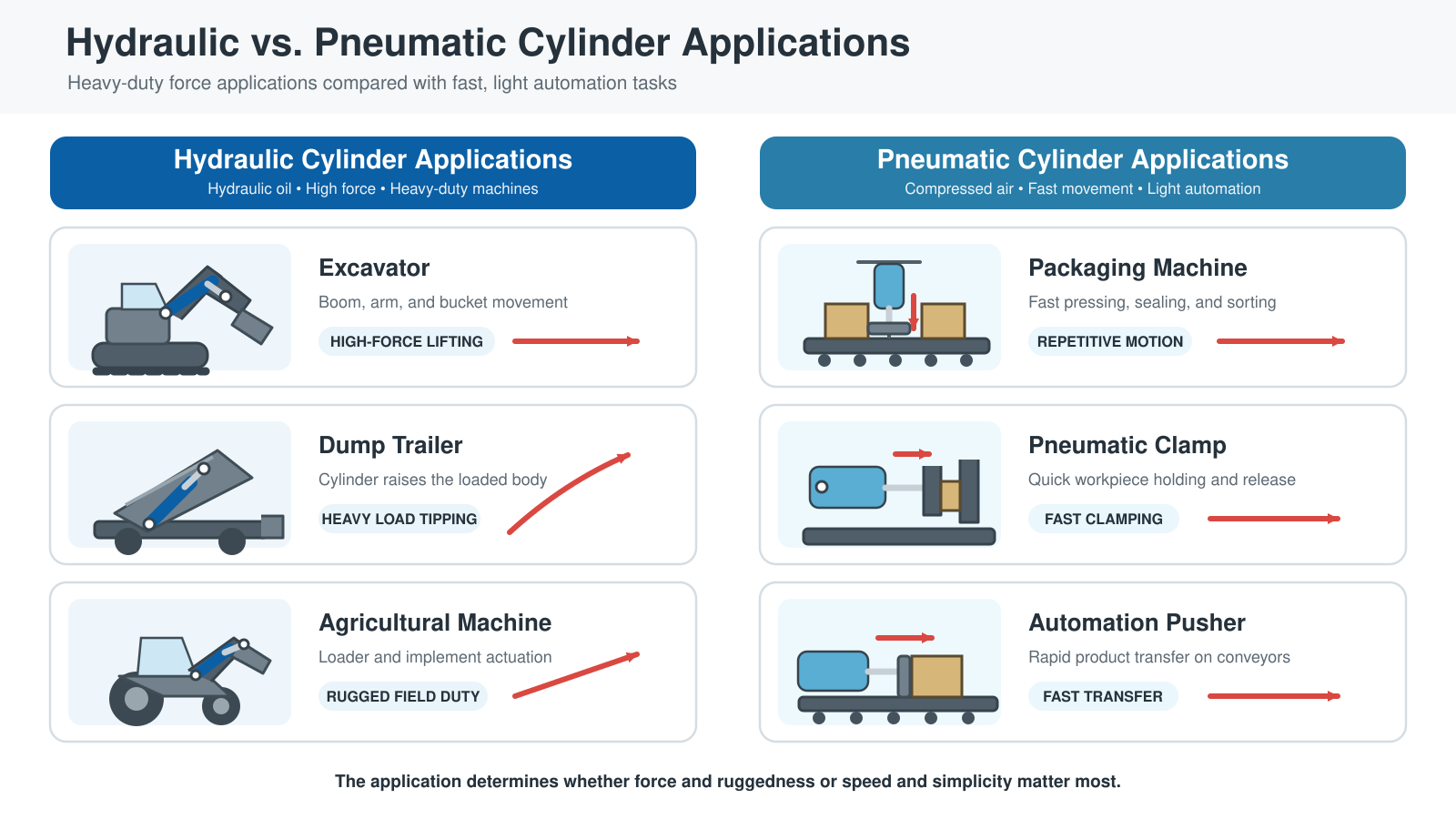
Can a Pneumatic Cylinder Replace a Hydraulic Cylinder?
Sometimes, but not always.
A pneumatic cylinder may replace a hydraulic cylinder if:
- The load is light
- The required force is low
- The motion is fast and simple
- Precise load holding is not required
- The machine already has a stable compressed air supply
- Clean operation is more important than high force
A pneumatic cylinder usually should not replace a hydraulic cylinder if:
- The load is heavy
- High force is required
- The cylinder must hold position under load
- The machine works outdoors or in harsh conditions
- The application involves shock load
- The cylinder is used for lifting heavy equipment
- Stable low-speed movement is required
In heavy machinery, agriculture, construction, trailers, and lifting equipment, replacing a hydraulic cylinder with a pneumatic cylinder is usually not a simple option.
Before replacement, engineers should calculate the required force, check available pressure, review installation space, and consider safety risks.
How to Choose Between Hydraulic and Pneumatic Cylinders
Choose a 유압 실린더 when:
- The load is heavy
- High pushing or pulling force is required
- Stable load holding is important
- The machine works in outdoor or heavy-duty conditions
- The application involves lifting, pressing, tilting, or pushing heavy structures
- The available system is hydraulic
- The cylinder must work with construction, agricultural, trailer, or industrial machinery
Choose a pneumatic cylinder when:
- The load is light
- The motion is fast and repetitive
- The environment should stay clean
- The machine already has compressed air
- The application is in factory automation
- Cost and simplicity are important
- Precise heavy-load holding is not required
A simple rule is:
For force and heavy-duty work, consider hydraulic.

For speed and light automation, consider pneumatic.
But the final selection should always be based on actual load, stroke, pressure, speed, installation space, environment, and safety requirements.
흔히 저지르는 실수
실수 1: 스트로크 길이만 살펴보기
Stroke length alone is not enough.
A hydraulic cylinder and a pneumatic cylinder may have the same stroke, but their force, speed, control, structure, and application suitability may be completely different.
For proper selection, you also need load, pressure, bore size, rod size, mounting type, speed, and working environment.
Mistake 2: Thinking Pneumatic Cylinders Can Replace Hydraulic Cylinders Easily
This is a common mistake.
A pneumatic cylinder can be a good choice for light-duty movement, but it is usually not suitable for replacing hydraulic cylinders in heavy-duty machines.
The main issue is force and load stability.
Mistake 3: Ignoring Air Compressibility
Compressed air is compressible. This affects positioning, cushioning, load holding, and low-speed stability.
This is why pneumatic cylinders are often excellent for fast automation but less suitable for heavy load holding.
Mistake 4: Ignoring Hydraulic Leakage Risk
Hydraulic cylinders can provide high force, but hydraulic systems require proper sealing, filtration, and maintenance.
Oil leakage can create contamination and safety issues, especially in sensitive environments.
실수 5: 용도를 파악하지 않고 실린더를 선택하는 것
A cylinder should always be selected according to the application.
주요 정보는 다음과 같습니다:
- 로드
- 뇌졸중
- 속도
- 작동 압력
- Available power source
- 장착 방식
- 설치 공간
- 듀티 사이클
- 근무 환경
- 안전 요건
Without this information, choosing between hydraulic and pneumatic cylinders becomes guesswork.
실무적인 공학적 고려 사항
In real projects, many customers ask only for stroke length. For example, they may say:
We need a 500 mm cylinder.
But this is not enough.
A 500 mm hydraulic cylinder for a dump trailer and a 500 mm pneumatic cylinder for a packaging machine are completely different products.
For hydraulic cylinder selection, engineers usually need:
- 구경
- 봉 지름
- 스트로크 길이
- 작동 압력
- 장착 방식
- 수축 시 길이
- 연장된 길이
- 부하 조건
- 신청
- 근무 환경
- Drawing or sample photo
If the machine needs high force, outdoor durability, stable lifting, or heavy-load movement, a hydraulic cylinder is usually the better starting point. If the machine needs clean, fast, light-duty repetitive motion, a pneumatic cylinder may be more suitable.
Compare the Complete System
The application table describes typical starting points, not universal winners. Assess load, air or oil supply, actual pressure, cushioning, exhaust or return restrictions, control requirements and life-cycle cost. Neither technology provides safe suspended-load holding merely because its cylinder is stationary.
요약
Hydraulic cylinders and pneumatic cylinders both create linear motion, but they are designed for different types of work.
A hydraulic cylinder uses pressurized oil. It is usually better for high force, heavy loads, stable movement, and harsh working conditions.
A pneumatic cylinder uses compressed air. It is usually better for fast, clean, simple, and light-duty automation.
The key difference is not only oil versus air. That difference affects force, speed, control, cleanliness, system complexity, maintenance, and application range.
If your application requires lifting, pushing, pulling, pressing, tilting, or holding a heavy load, a hydraulic cylinder is often the better choice. If your application requires fast, light, repetitive motion in a clean factory environment, a pneumatic cylinder may be the better option.
If you are not sure which one to choose, prepare your load, stroke, speed, pressure source, mounting type, and working environment. An engineer can review these details and help select the correct cylinder type.
자주 묻는 질문
유압 실린더와 공압 실린더의 차이점은 무엇인가요?
A hydraulic cylinder uses pressurized hydraulic oil, while a pneumatic cylinder uses compressed air. Hydraulic cylinders are usually better for high force and heavy-duty applications. Pneumatic cylinders are usually better for fast, clean, light-duty automation.
Is a hydraulic cylinder stronger than a pneumatic cylinder?
In most industrial applications, yes. Hydraulic cylinders usually generate much higher force because hydraulic systems commonly operate at higher pressure and use oil to transmit force effectively.
Can a pneumatic cylinder replace a hydraulic cylinder?
Sometimes, but only in light-duty applications with low force requirements. For heavy loads, stable holding, lifting, pressing, or outdoor machinery, a pneumatic cylinder usually cannot replace a hydraulic cylinder directly.
Which is faster, a hydraulic cylinder or a pneumatic cylinder?
Pneumatic cylinders are often faster in light-duty automation. Hydraulic cylinder speed depends on pump flow, valve size, hose size, cylinder size, and load.
Which is better for heavy loads?
A hydraulic cylinder is usually better for heavy loads because it can generate higher force and provide more stable load control.
Are pneumatic cylinders cleaner than hydraulic cylinders?
In many applications, yes. Pneumatic cylinders use compressed air, so there is no hydraulic oil leakage risk. This makes them suitable for many clean light-duty automation applications.
When should I use a hydraulic cylinder?
Use a hydraulic cylinder when the application requires high force, heavy-load movement, stable load holding, lifting, pressing, tilting, or outdoor heavy-duty operation.
When should I use a pneumatic cylinder?
Use a pneumatic cylinder when the application requires fast, simple, clean, repetitive motion with relatively light loads.
기술 관련 참고 자료 및 읽을거리
여기서 논의된 범위와 기술적 차이점을 뒷받침하는 출처: Festo 액추에이터 및 구동 장치; 페스토 공압식 vs 전기식: 올바른 선택 방법; ISO 4413:2010 Hydraulic System Safety. Detailed standards clauses, application limits and machine-specific procedures require engineering review before use.
관련 기사
신청서 검토에 도움이 필요하신가요? 엔지니어링 검토를 위해 작동 조건, 부하 및 동작 요구 사항, 도면을 준비해 주세요.
관련 기사

유압 실린더란 무엇인가? 정의, 구성 부품 및 작동 원리
유압 실린더는 어떻게 작동할까요? 신장 및 수축에 대한 간단한 안내

유압 실린더 대 전동 액추에이터: 어느 쪽을 선택해야 할까요?
이 유압 지식을 적용하는 데 도움이 필요하신가요?
도면, 사진, 작동 압력, 장비 세부 정보 또는 적용 관련 문의 사항을 보내 주십시오.