Welded Hydraulic Cylinder: Construction, Serviceability, and Specification
Understand welded hydraulic cylinder construction, gland retention, service access, and the information needed to compare a replacement or new design.
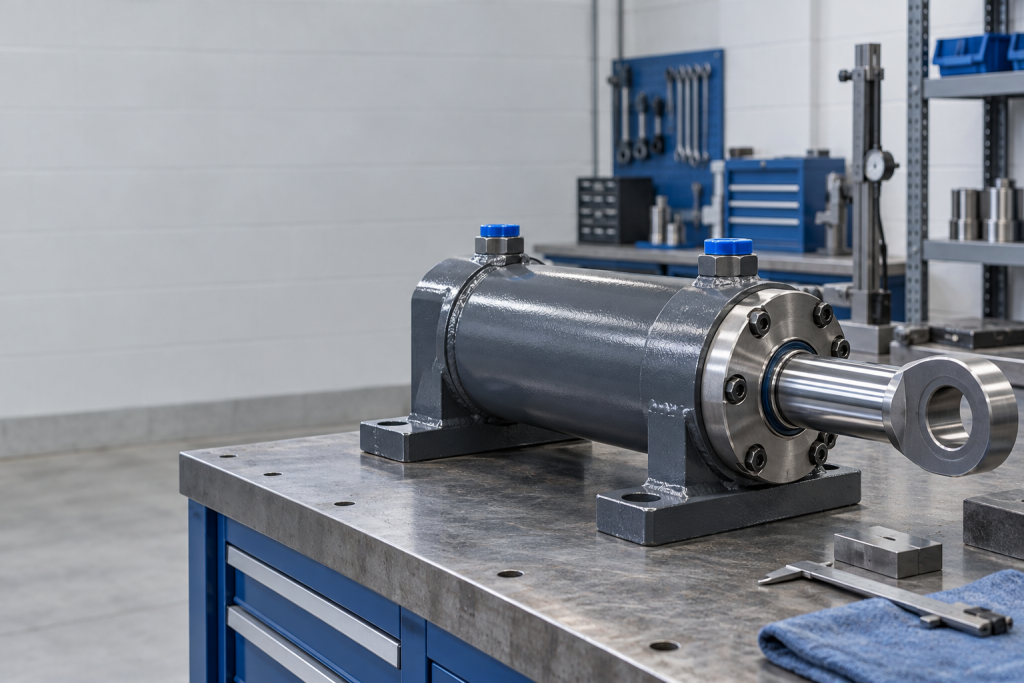
A welded hydraulic cylinder uses welded joints in its body construction, commonly joining the barrel to the base and incorporating selected ports or mounting features. The name describes how the structure is assembled; it does not specify whether the cylinder is single-acting or double-acting, nor does it establish a pressure rating. It also does not mean that every component is permanently welded in place. Many designs retain a removable head or gland so the moving assembly and seals can be serviced. This guide explains the construction details that matter when identifying a cylinder, reviewing installation space, or comparing a replacement. The central task is to read the actual joint and retention arrangement rather than infer performance from the type name.
目次
What the welded construction describes
Start with the pressure-containing body. In a common welded-body arrangement, the base is joined to the barrel by a weld, while the rod exits through a separately retained head. Other designs use different combinations of welded and detachable connections.
Eagle Hydraulic describes a welded barrel-to-cap connection and several possible head retention methods. That is useful evidence of construction variety, not proof that all welded cylinders share one design. Eagle welded-body cylinder overview.
The familiar moving parts still have their usual jobs. The piston separates working regions where the design requires it, the rod transmits force, and guides support the moving assembly. The main cylinder parts guide explains these functions separately from the method of joining the body.
Do not confuse “welded cylinder” with permission to weld onto an existing cylinder. A weld added during a machine modification changes a specific manufactured component. Its location, heat effects, load path, cleanliness, and subsequent inspection require engineering consideration.
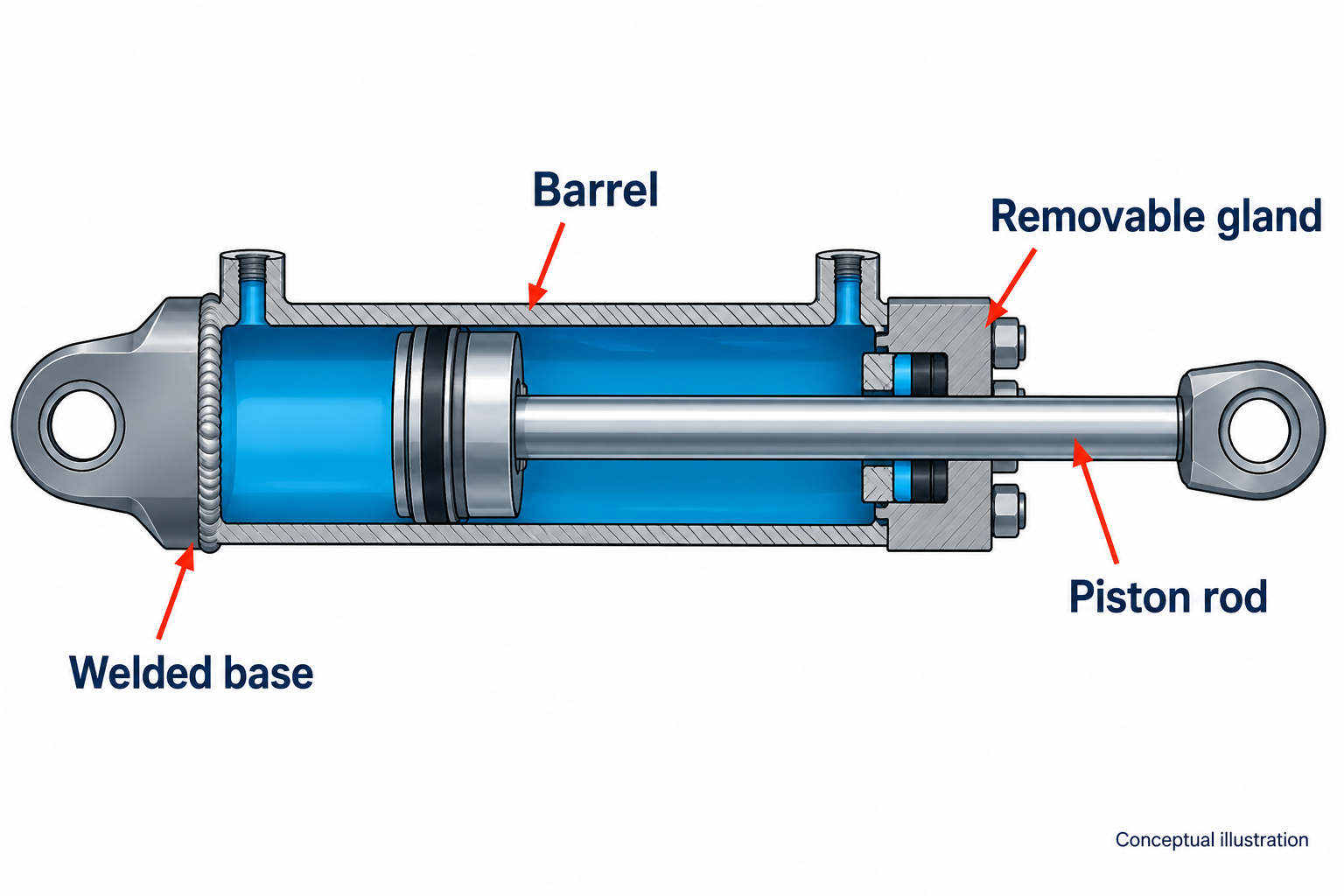
The gland can still be removable
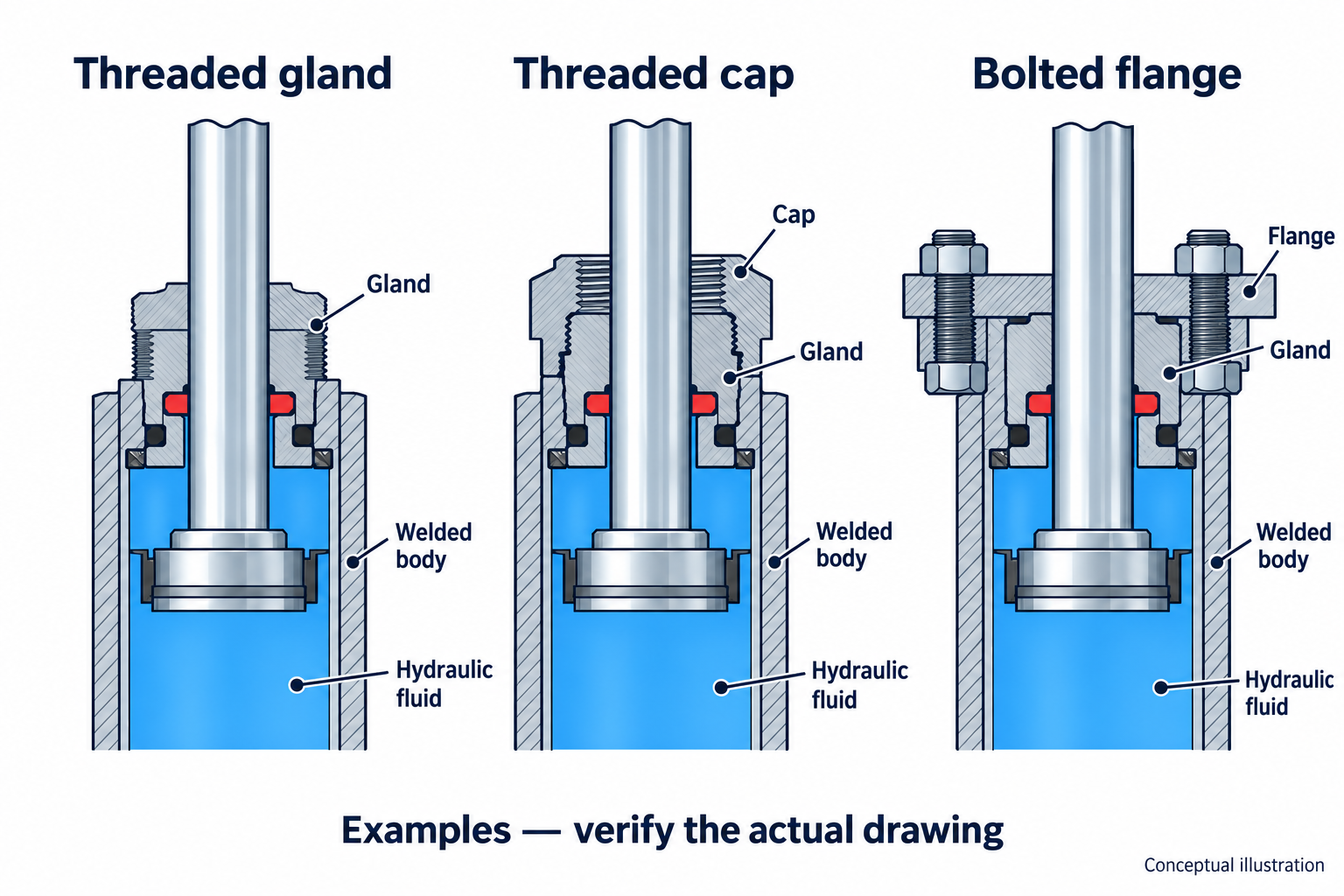
Head retention is one of the first details to identify on the drawing. The visible end shape alone may not reveal how the assembly is secured.
| Retention concept | What to identify in the documentation |
|---|---|
| Threaded gland | The engaged thread, retention feature, and specified service method |
| Separate threaded cap or nut | How the cap retains the gland and how the assembly is locked |
| Bolted retaining flange | The retaining components and applicable assembly specification |
| Retaining ring or wire arrangement | The exact groove and retaining-element design |
| Permanently joined head | The intended service or replacement route |
Aurelius illustrates threaded-retainer, threaded-nut, and bolted-flange build styles within its welded-cylinder design information. These examples show why body construction and head retention should be recorded as separate attributes. Aurelius cylinder build types.
A removable gland is not necessarily interchangeable with another gland of similar outside diameter. Thread form, engagement, locating surfaces, seal grooves, guide length, and pressure loading belong to the specific assembly.
The head and gland article explains the component's role. This overview does not provide a removal sequence, tightening torque, or method for releasing a retaining element.
Packaging and load paths need separate checks
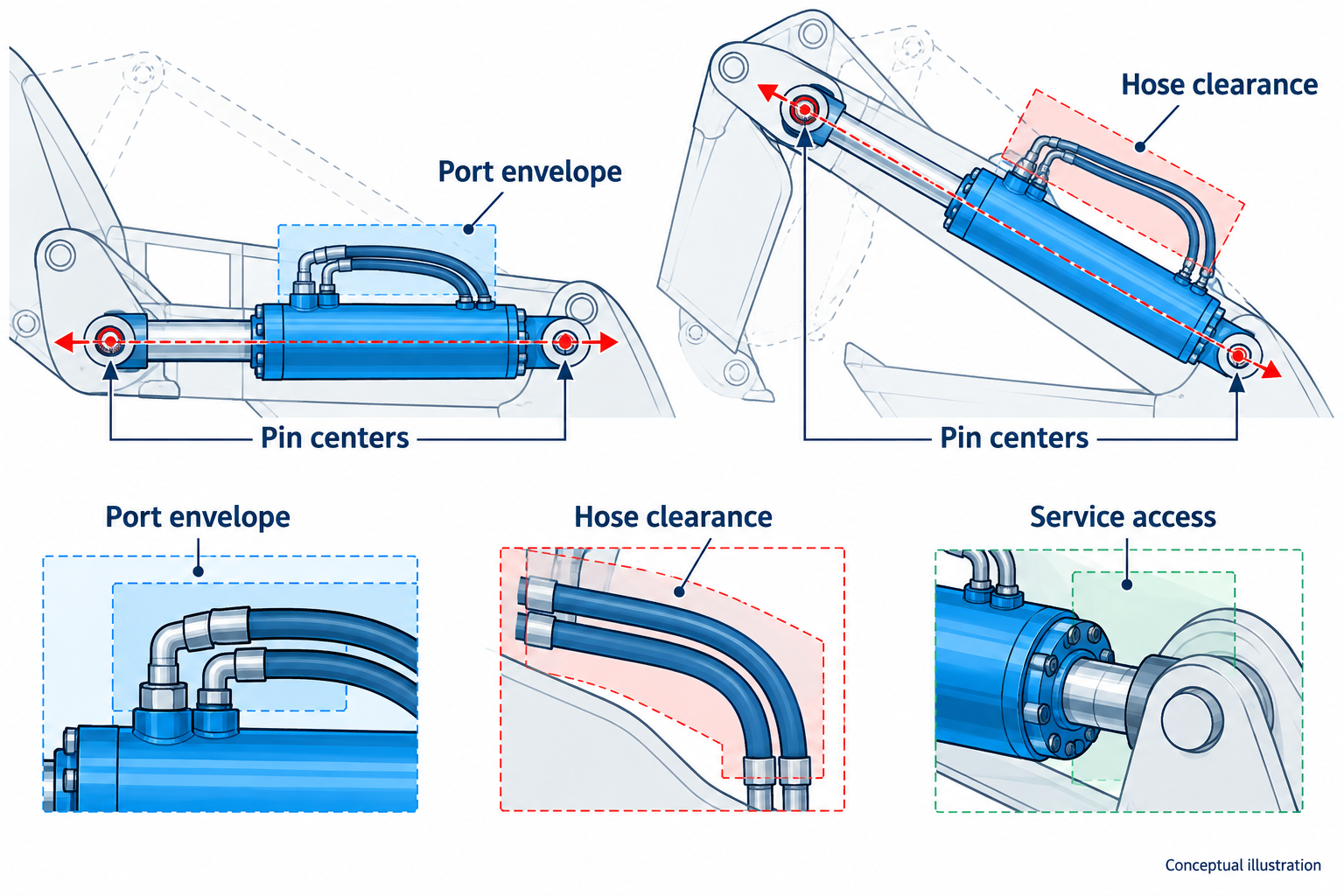
Without external body tie rods, a welded-body layout can offer useful freedom around the barrel. That can help the designer place mounts and ports within a machine envelope. The actual space benefit, however, must be checked on a dimensional drawing.
Include more than the tube diameter. A port boss, hose fitting, retaining flange, pivot lug, or sensor connection may define the largest local envelope. The machine also needs clearance during movement, not only when the cylinder is retracted.
Structural suitability is another question. Pressure loads travel through the barrel and its end connections. Machine loads travel through the rod, attachments, mounts, and surrounding structure. Those paths interact, but a compact outline does not demonstrate adequate fatigue life or resistance to misalignment.
Compare the mounting arrangement with the permitted movement at each end. A welded cross-tube or lug still needs suitable pin geometry, bearing support, and alignment. See mounting ends when preparing that part of the review.
A design comparison should therefore separate three claims: it fits the space, it supplies the required motion, and it withstands the specified duty. Each claim needs its own evidence. None follows automatically from the word “welded.”
Serviceability is a design detail
Serviceability includes access, identification, replaceable components, approved procedures, and the condition of the remaining structure. A removable head helps only if the installation provides the necessary access and the correct service information is available.
Consider an original purchasing example. Two cylinders have the same nominal bore and stroke. One has a serviceable gland with a documented seal kit; the other supplier has supplied only an overall drawing and no service identification. Their dimensions may look similar, but their maintenance provisions have not yet been shown equivalent.
Ask whether the parts list identifies the gland, piston, rod, seals, guides, and retaining hardware separately. Establish which items are intended to be replaced and which findings require replacement of a larger assembly.
Inspection also needs context. External leakage near a connection, damaged paint, or an unusual surface mark is an observation, not a complete diagnosis. A suspected pressure-boundary defect requires the responsible service process rather than an improvised weld repair.
Welding on an assembled or previously operated cylinder introduces issues beyond replacing a seal. The material condition, residual fluid, internal contamination, distortion, and verification requirements must be addressed by qualified personnel under an approved procedure. This article is not such a procedure.
「」を使用してください cylinder drawing and its revision history to connect the installed unit to the correct service documentation. A drawing for a visually similar unit may describe a different retention arrangement.
How to compare a proposed replacement
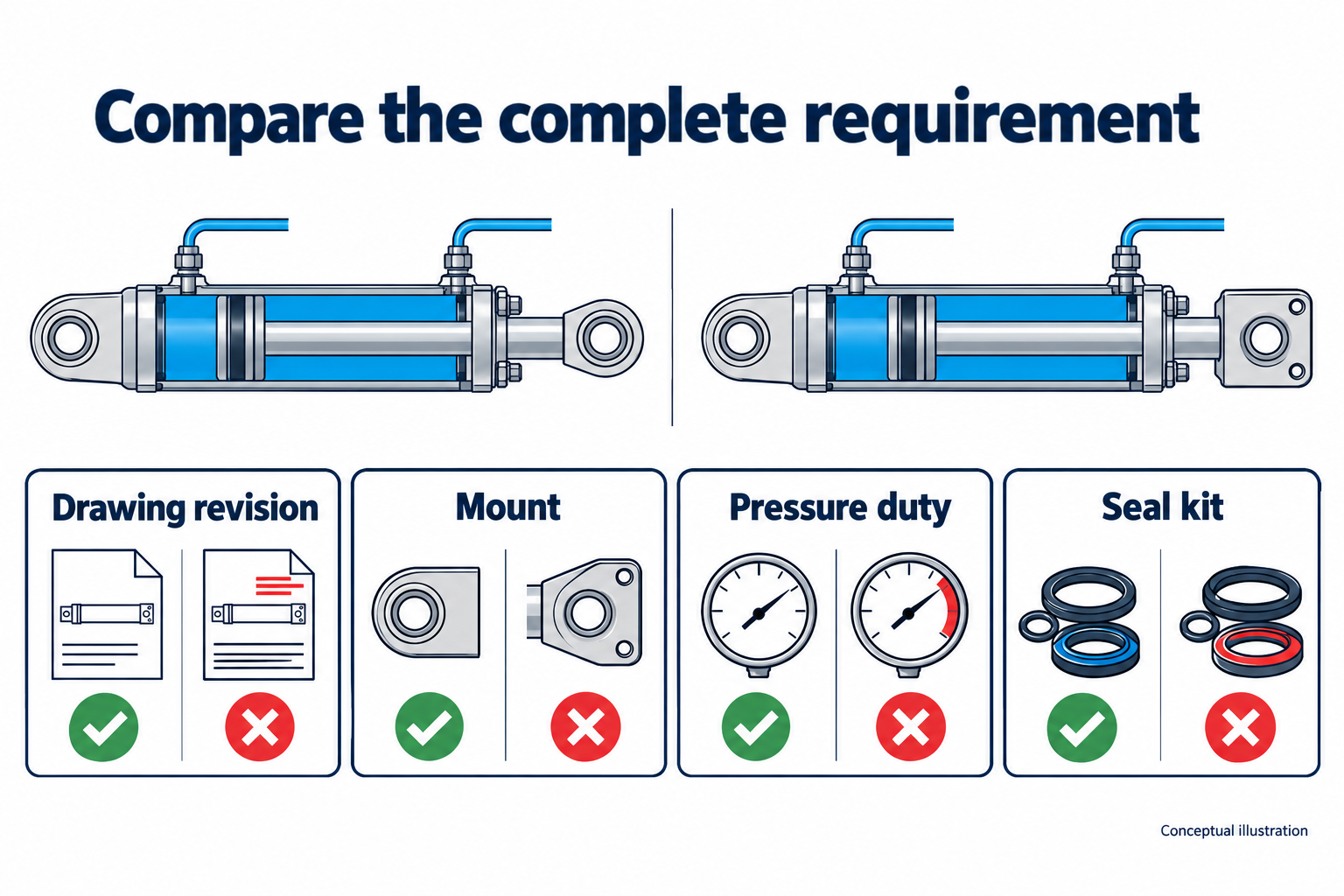
Begin with the machine requirement, then compare the proposed cylinder against it. Matching bore and stroke is necessary in some replacements, but it is rarely a complete equivalence check.
Record at least:
- Bore, rod diameter, usable stroke, and relevant length datums.
- Mount type, pin sizes, widths, alignment, and movement limits.
- Port thread, sealing method, orientation, and access.
- Working pressure conditions, load direction, and duty cycle.
- Fluid identity, temperature range, and environmental exposure.
- Seal and guide arrangement, material requirements, and surface protection.
- Head retention, service clearances, and replacement-part identification.
- Inspection, acceptance, and documentation requirements.
Keep requirements separate from offered features. “Heavy duty” is not a measurable substitute for a load spectrum or specified acceptance criterion. Likewise, a supplier's maximum manufacturing capability is not the rating of the proposed cylinder.
For a new design, identify what is fixed and what can change. The machine may allow a different port location but require identical mounting centers. A replacement may need to preserve an existing maintenance method. Clear priorities prevent a supplier from solving the wrong packaging problem.
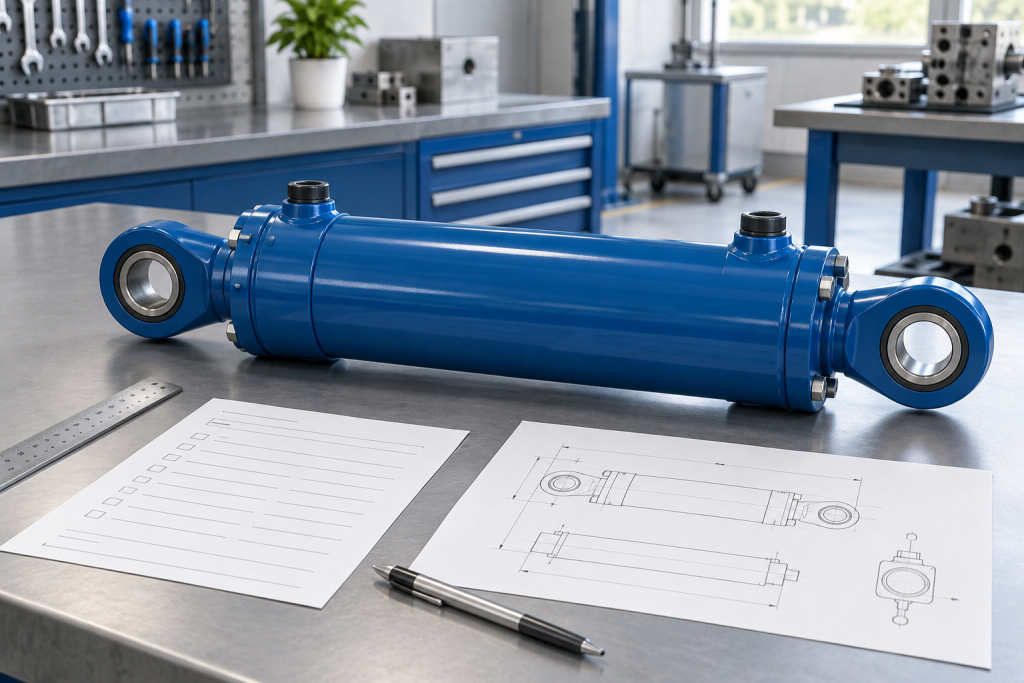
その cylinder RFQ checklist provides a place to organize this information. Any unresolved pressure-boundary, weld, or fatigue requirement belongs in the technical review rather than in an assumed equivalence statement.
Welded cylinder questions answered
Can a welded hydraulic cylinder be rebuilt?
Some designs allow seal and moving-assembly service through a removable head. The actual repair scope depends on construction, condition, parts availability, and the manufacturer's procedure.
Is a welded cylinder always stronger than a tie-rod cylinder?
No universal ranking follows from the construction name. Compare specific designs against pressure, loads, mounting, duty, and verification requirements.
Does welded construction mean there are no static seals?
No. Detachable heads, ports, and other joints may still use static seals. Identify each fluid boundary on the actual drawing.
Can a mounting bracket be welded onto the barrel during installation?
Do not treat that as a routine fitting adjustment. It changes the cylinder and needs a specific engineering decision and qualified manufacturing process.
Before accepting a replacement, collect the assembly drawing, operating duty, and service requirements together. They provide a reviewable basis for deciding whether the offered welded cylinder is suitable.
関連記事

How to Read a Hydraulic Cylinder Drawing and Specification Sheet
Hydraulic Cylinder Specification and RFQ Checklist
この油圧に関する知識を応用する上で、お手伝いが必要ですか?
図面、写真、使用圧力、機器の詳細、または用途に関するご質問などをお送りください。.