Qu'est-ce qu'un vérin hydraulique ? Définition, composants et principe de fonctionnement
Learn what a hydraulic cylinder is, how it works, its main parts and types, and which specifications matter when reviewing a hydraulic application.

A vérin hydraulique is a mechanical actuator that uses pressurized hydraulic oil to create strong linear force and motion. In simple terms, it helps a machine push, pull, lift, lower, press, or move a load in a straight line.
Hydraulic cylinders are widely used in construction machinery, agricultural equipment, dump trucks, forklifts, trailers, lifting platforms, press machines, marine equipment, and many other industrial machines. Whenever a machine needs reliable and powerful linear movement, a hydraulic cylinder is often one of the most important components.
This guide explains what a hydraulic cylinder is, how it works, what parts it includes, the common types of hydraulic cylinders, where they are used, and what basic parameters you should understand before selecting or buying one.
Sommaire
- Qu'est-ce qu'un vérin hydraulique ?
- Comment fonctionne un vérin hydraulique ?
- Main Parts of a Hydraulic Cylinder
- Common Types of Hydraulic Cylinders
- Where Are Hydraulic Cylinders Used?
- Basic Hydraulic Cylinder Parameters You Should Know
- Hydraulic Cylinder vs Hydraulic Actuator
- Hydraulic Cylinder vs Pneumatic Cylinder
- When Do You Need a Custom Hydraulic Cylinder?
- How to Choose the Right Hydraulic Cylinder: Basic Starting Points
- Common Mistakes Beginners Make When Understanding Hydraulic Cylinders
- Hypothèses relatives à la force et à la vitesse
- Résumé
- FAQ
- Ressources techniques et lectures complémentaires
- Articles connexes
Qu'est-ce qu'un vérin hydraulique ?
A hydraulic cylinder is a device that converts hydraulic energy into mechanical linear motion.
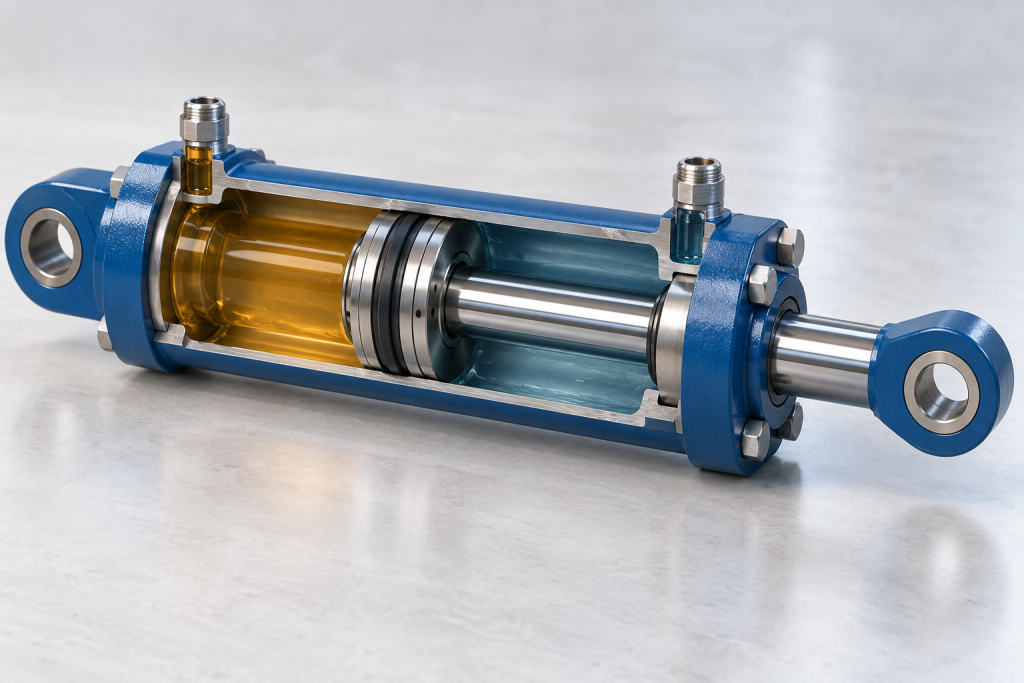
In a hydraulic system, the hydraulic pump supplies oil flow. When this oil flow meets resistance from a load, pressure builds in the system. The pressurized oil enters the hydraulic cylinder and acts on the piston area. This pressure pushes the piston, and the piston moves the piston rod in or out of the cylinder.
The result is straight-line mechanical movement.
A hydraulic cylinder is also a type of hydraulic actuator. An actuator is a component that turns energy into motion. In this case, the energy comes from pressurized hydraulic oil, and the motion is linear movement.
A basic hydraulic cylinder usually includes:
- Cylinder barrel
- Piston
- Piston rod
- Sceaux
- Cylinder head or gland
- End cap or base
- Oil ports
- Mounting ends
The cylinder does not work alone. It is usually part of a complete hydraulic system that includes a pump, valves, hoses, oil tank, filters, and other components. The pump provides oil flow, the valves control direction, and the hydraulic cylinder performs the actual movement.
Comment fonctionne un vérin hydraulique ?
The working principle of a hydraulic cylinder is based on hydraulic pressure acting on an area.
The basic process is:
- The hydraulic pump sends hydraulic oil into the system.
- A control valve directs the oil into one side of the cylinder.
- The oil enters the cylinder through an oil port.
- Pressure acts on the piston area.
- The piston moves inside the cylinder barrel.
- The piston rod extends or retracts.
- The cylinder creates linear force and movement.
For example, when pressurized oil enters the cap end of a double-acting cylinder, it pushes the piston forward and extends the piston rod. When oil enters the rod end, it pushes the piston in the opposite direction and retracts the rod.
The force of a hydraulic cylinder depends mainly on two factors:
- Hydraulic pressure
- Piston area
In simple terms, higher pressure or a larger piston area can create more force. This is why hydraulic cylinders are often used in machines that need much higher force than electric or pneumatic systems can easily provide.
The detailed force calculation involves formulas such as pressure multiplied by area, but this article only covers the basic concept. Cylinder force calculation should be studied separately when selecting or designing a cylinder.

Main Parts of a Hydraulic Cylinder
Different hydraulic cylinders may have different designs, but most cylinders share several basic parts.
Canon
Le canon is the main tube of the hydraulic cylinder. The piston moves inside the barrel.
The inner surface of the barrel needs to be smooth and accurate because it directly affects sealing performance, friction, and service life. In many hydraulic cylinders, honed tubes are used to provide a good internal surface finish.
A poor barrel surface can damage piston seals, increase leakage, and reduce cylinder life.
Tige de piston
Le tige de piston transfers force from the piston to the machine.
When the cylinder extends or retracts, the piston rod moves in and out of the cylinder. It must be strong enough to handle load, impact, bending risk, and working environment. In many hydraulic cylinders, the piston rod is chrome-plated to improve wear resistance and corrosion resistance.
Rod diameter is an important parameter. A rod that is too small may bend under heavy load or long stroke conditions.
Piston
Le piston is located inside the cylinder barrel. It separates the cylinder into different oil chambers and receives pressure from hydraulic oil.
When pressurized oil acts on the piston, the piston moves inside the barrel. The piston is usually fitted with piston seals to reduce internal leakage between chambers.
If piston seals are damaged, the cylinder may lose force, drift under load, or fail to hold position.
Cylinder Head or Gland
Le culasse, sometimes called the glande, is located at the rod end of the cylinder.
Its main functions are to guide the piston rod, support sealing elements, and help keep the rod aligned during movement. It usually contains rod seals, wiper seals, and guide elements.
A well-designed gland helps reduce rod movement, seal wear, and leakage.
End Cap or Cylinder Base
Le end cap ou cylinder base closes the back end of the cylinder.
In some designs, the base also includes a mounting structure, such as a clevis, eye, flange, or welded bracket. In welded hydraulic cylinders, the base may be welded directly to the cylinder barrel.
This part must be strong enough to transfer cylinder force safely to the machine structure.
Sceaux
Hydraulic cylinder seals are critical for performance.
They prevent oil leakage, separate pressure areas, and protect the cylinder from contamination. Common seals include:
- Joints de piston
- Joints de tige
- Wiper seals
- Joints statiques
- Joints toriques
- Wear rings or guide rings
Piston seals help prevent internal leakage between oil chambers. Rod seals prevent oil from leaking out around the piston rod. Wiper seals help keep dust, dirt, and moisture away from the cylinder.
Seal quality has a major influence on leakage control, working stability, and service life.
Oil Ports
Oil ports allow hydraulic oil to enter and leave the cylinder.
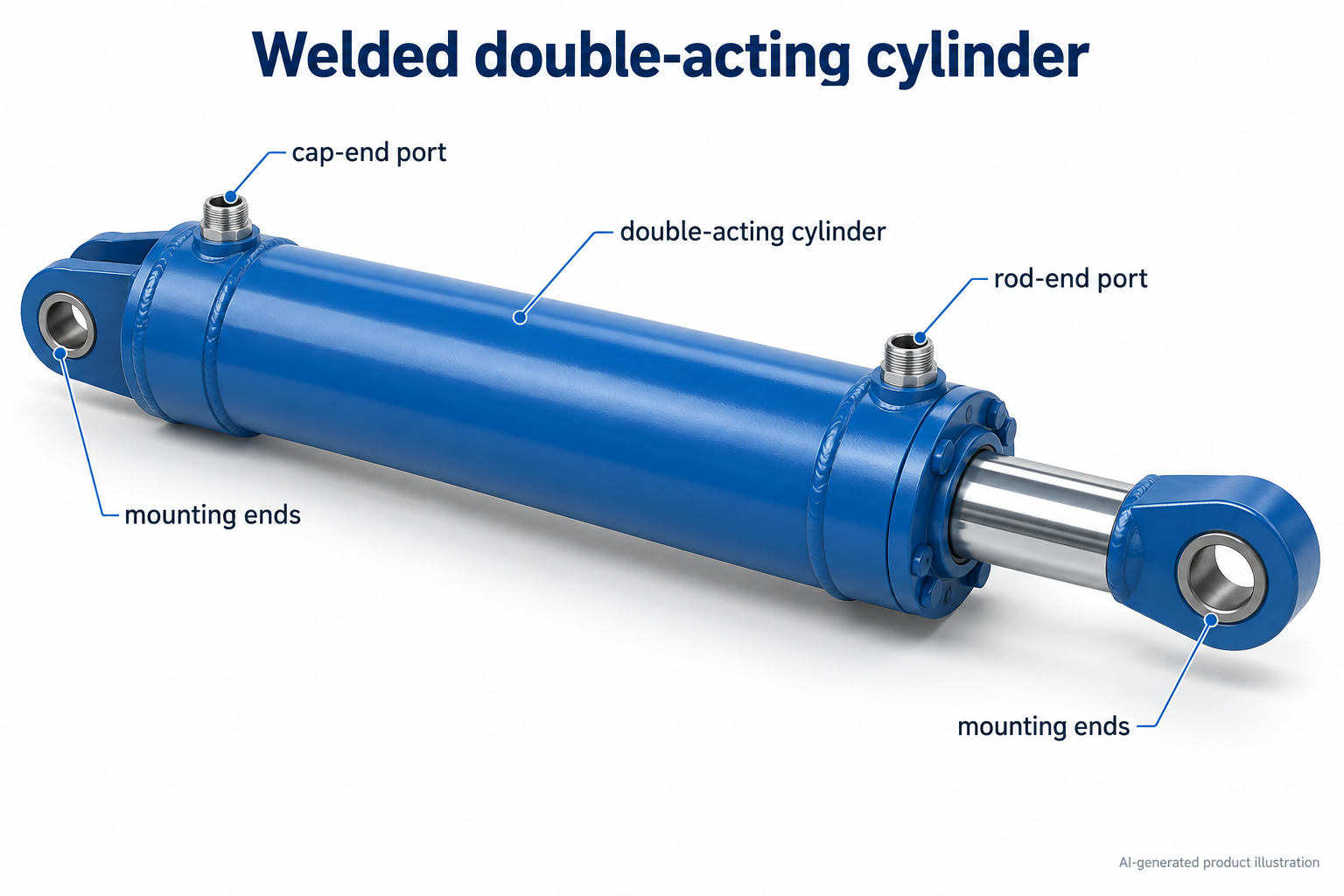
A single-acting cylinder may have one main oil port. A double-acting cylinder usually has two oil ports: one for extension and one for retraction.
Port size, thread type, and port location depend on the cylinder design, oil flow, installation space, and application requirements.
Mounting Ends
Mounting ends connect the hydraulic cylinder to the machine.
Les types de montage courants sont les suivants :
- Rod eye
- Chape
- Roulement sphérique
- Bride
- Tourillon
- Pin mount
Correct mounting is very important. Poor alignment or incorrect mounting can create side load, which may damage the piston rod, seals, bushings, and guide parts.

Common Types of Hydraulic Cylinders
There are many hydraulic cylinder designs. The most common types include single-acting, double-acting, welded, tie-rod, telescopic, and custom hydraulic cylinders.
Vérin hydraulique à simple effet
A vérin hydraulique à simple effet uses hydraulic pressure to move the cylinder in one direction only.
The return movement is usually caused by gravity, spring force, or an external load. For example, some lifting cylinders extend by hydraulic pressure and retract when the load lowers.
Single-acting cylinders are often used in simple lifting or pushing applications where controlled movement in both directions is not required.
Vérin hydraulique à double effet
A vérin hydraulique à double effet utilise la pression hydraulique aussi bien pour l'extension que pour la rétraction.
It usually has two oil ports. One port sends oil to extend the rod, and the other sends oil to retract the rod. This design gives better control in both directions.
Double-acting cylinders are widely used in construction machinery, agricultural equipment, material handling machines, trailers, industrial equipment, and many custom machines.
Vérin hydraulique soudé
A vérin hydraulique soudé has a compact and strong structure. The cylinder body is usually welded together, instead of being held by external tie rods.
Welded cylinders are commonly used in mobile machinery, agricultural equipment, construction equipment, trailers, forklifts, and other machines where compact structure and high strength are important.
From a manufacturing point of view, welded cylinders are often suitable for custom machine designs because the mounting ends, ports, stroke, and installation dimensions can be designed according to the machine structure.
Vérin hydraulique à tirant
A vérin hydraulique de barre de direction uses long tie rods to hold the cylinder assembly together.
Tie-rod cylinders are common in industrial equipment, factory automation, and standard hydraulic applications. They are often easier to disassemble and maintain compared with some welded designs.
However, their structure may take more space, so they are not always the best choice for compact mobile machinery.
Vérin hydraulique télescopique
A vérin hydraulique télescopique uses multiple stages to achieve a long stroke while keeping a shorter retracted length.
This type of cylinder is commonly used in dump trucks, tipper trailers, lifting platforms, and machines where the cylinder must extend a long distance but has limited installation space when retracted.
Telescopic cylinders can be single-acting or double-acting, depending on the application.
Vérin hydraulique sur mesure
A vérin hydraulique sur mesure is designed according to specific machine requirements.
A standard cylinder may not fit every machine. Custom cylinders are often needed when the application has special requirements for:
- Bore diameter
- Diamètre de la tige
- Longueur de course
- Pression de service
- Type de montage
- Oil port position
- Espace d'installation
- Environnement de travail
- Traitement de surface
- Seal material
- Load and speed
For OEM machinery, custom hydraulic cylinders are often designed based on drawings, samples, or machine working conditions.
Where Are Hydraulic Cylinders Used?
Hydraulic cylinders are used in many industries because they can produce strong and reliable linear force.
Engins de chantier
In construction machinery, hydraulic cylinders are used for lifting, digging, pushing, steering, tilting, and positioning.
Parmi les applications courantes, on peut citer :
- Pelles mécaniques
- Chargeuses
- Bulldozers
- Grues
- Concrete machinery
- Road construction equipment
Excavators, for example, use boom cylinders, arm cylinders, and bucket cylinders to control digging movement.
Machines agricoles
Agricultural machines use hydraulic cylinders for lifting, folding, steering, adjusting, and positioning equipment.
Parmi les applications courantes, on peut citer :
- Tracteurs
- Semoirs
- Presses à balles
- Moissonneuses
- Pulvérisateurs
- Plows
- Chargeuses frontales
Agricultural cylinders often need to handle outdoor working conditions, dust, mud, vibration, and corrosion.
Material Handling Equipment
Hydraulic cylinders are also widely used in material handling equipment.
En voici quelques exemples :
- Chariots élévateurs
- Plates-formes élévatrices à ciseaux
- Hayons élévateurs
- Tables élévatrices
- Pallet handling equipment
- Warehouse equipment
These machines often require stable lifting and lowering movement.
Trucks and Trailers
Truck and trailer applications often use hydraulic cylinders for lifting or tilting.
En voici quelques exemples :
- Camions à benne basculante
- Remorques à benne basculante
- Camions-poubelles
- Car carriers
- Tailgate lifts
Telescopic cylinders are especially common in dump trucks and tipper trailers because they can provide long lifting stroke in limited installation space.
Équipements industriels
In industrial machines, hydraulic cylinders are used for pressing, clamping, feeding, pushing, and positioning.
En voici quelques exemples :
- Presses hydrauliques
- Injection molding machines
- Machines-outils
- Automation equipment
- Metal forming machines
- Recycling equipment
Industrial cylinders may require high precision, stable movement, and long working life.
Marine and Special Equipment
Hydraulic cylinders are also used in marine, offshore, and special equipment.
En voici quelques exemples :
- Hatch covers
- Systèmes de direction
- Offshore platforms
- Lifting devices
- Special-purpose machinery
In these environments, corrosion resistance, sealing performance, and material selection can be very important.

Basic Hydraulic Cylinder Parameters You Should Know
Before selecting or buying a hydraulic cylinder, it is important to understand several basic parameters.
Diamètre intérieur
Bore diameter correspond au diamètre intérieur du canon.
It affects the output force of the cylinder. At the same pressure, a larger bore can usually generate more pushing force because the piston area is larger.
Bore diameter is one of the most important parameters in hydraulic cylinder selection.
Diamètre de la tige
Diamètre de la tige is the diameter of the piston rod.
It affects the strength, stability, and pull force of the cylinder. A larger rod diameter can improve resistance to bending, especially in long-stroke or heavy-load applications.
However, rod diameter also affects the effective area on the rod side, which influences pulling force in a double-acting cylinder.
Stroke Length
Longueur de course is the distance the cylinder can extend or retract.
For example, if a cylinder has a 500 mm stroke, the piston rod can move 500 mm from the fully retracted position to the fully extended position.
Stroke length must match the required movement range of the machine.
Pression de service
Pression de service is the hydraulic pressure that the cylinder is designed to operate under.
The cylinder structure, wall thickness, seals, welding, and safety margin must be suitable for the required pressure. Higher pressure can create higher force, but it also increases stress on the cylinder and hydraulic system.
Retracted Length and Extended Length
Longueur en position rétractée is the total cylinder length when it is fully closed.
Longueur allongée is the total cylinder length when it is fully open.
These dimensions are important because the cylinder must fit into the available installation space of the machine.
Type de fixation
Type de montage defines how the cylinder connects to the machine.
Common mounting types include:
- Rod eye
- Chape
- Roulement sphérique
- Bride
- Tourillon
- Pin mount
Correct mounting helps the cylinder move smoothly and reduces side load. Incorrect mounting can shorten cylinder life and cause rod, seal, or bearing damage.
Hydraulic Cylinder vs Hydraulic Actuator
A hydraulic cylinder is one type of hydraulic actuator.
The term hydraulic actuator is broader. It refers to any hydraulic component that converts hydraulic energy into mechanical movement.
Hydraulic actuators can create:
- Linear motion
- Rotary motion
A hydraulic cylinder creates linear motion. A hydraulic motor or rotary actuator creates rotary motion.
In many everyday discussions, people may use “hydraulic cylinder” and “hydraulic actuator” in a similar way, especially when talking about linear movement. However, technically, a hydraulic cylinder is only one category of hydraulic actuator.
Hydraulic Cylinder vs Pneumatic Cylinder
Hydraulic cylinders and pneumatic cylinders may look similar, but they work in different ways.
A hydraulic cylinder uses hydraulic oil. A pneumatic cylinder uses compressed air.
The main differences include:
| Item | Vérin hydraulique | Pneumatic Cylinder |
|---|---|---|
| Working medium | Hydraulic oil | Compressed air |
| Force | Usually higher | Usually lower |
| Load capacity | Heavy-duty applications | Light-duty applications |
| Motion stability | Strong and stable | Fast but more compressible |
| Common use | Construction, agriculture, lifting, pressing | Light automation, packaging, small machines |
Hydraulic oil is much less compressible than air, so hydraulic cylinders can provide strong and stable force. This makes them suitable for heavy-duty machines.
Pneumatic cylinders are often used in cleaner, faster, lighter-duty automation applications.
When Do You Need a Custom Hydraulic Cylinder?
You may need a custom hydraulic cylinder when a standard cylinder cannot meet your machine’s requirements.
This is common in OEM machinery, special equipment, agricultural machines, construction equipment, and industrial machines.
A custom hydraulic cylinder may be needed when you have special requirements for:
- Bore diameter
- Diamètre de la tige
- Longueur de course
- Longueur en position rétractée
- Longueur allongée
- Type de montage
- Oil port position
- Pression de service
- Load capacity
- Vitesse
- Seal material
- Traitement de surface
- Résistance à la corrosion
- Working temperature
- Espace d'installation
For example, two machines may both need a 500 mm stroke cylinder, but the mounting type, rod diameter, working pressure, oil port direction, and installation length may be completely different.
For custom cylinder design, engineers usually need a drawing, sample cylinder, or basic parameter sheet. Important information includes bore, rod diameter, stroke, working pressure, mounting type, application, and working environment.
Need help checking whether your machine needs a standard or custom hydraulic cylinder? Prepare your basic parameters or drawing for engineering review.
How to Choose the Right Hydraulic Cylinder: Basic Starting Points
Choosing a hydraulic cylinder is not only about stroke length.
Before selecting a cylinder, you should understand the working conditions of the machine.
Basic questions include:
- What force is required?
- What stroke length is needed?
- What working pressure is available?
- What installation space is available?
- What mounting type is required?
- What load direction does the cylinder handle?
- Will the cylinder face side load?
- What speed is required?
- What environment will the cylinder work in?
- Does the machine need a standard or custom cylinder?
For a simple replacement, an existing drawing or sample cylinder may be enough.
For a new machine design, more engineering information may be needed, including load, movement range, mounting position, working pressure, duty cycle, and environmental conditions.
Detailed sizing, force calculation, and rod selection should be handled in a separate hydraulic cylinder selection guide.
Common Mistakes Beginners Make When Understanding Hydraulic Cylinders
Mistake 1: Only Looking at Stroke Length
Many beginners only ask for the stroke length.
Stroke is important, but it is not enough. A hydraulic cylinder also needs the correct bore, rod diameter, pressure rating, mounting type, and installation dimensions.
Two cylinders with the same stroke may have completely different force capacity and structure.
Mistake 2: Ignoring Mounting and Side Load
A hydraulic cylinder is designed mainly for linear force. If the mounting is incorrect, the cylinder may experience side load.
Side load can damage the piston rod, seals, guide rings, bushings, and mounting parts. Good alignment is important for cylinder life.
Mistake 3: Thinking All Hydraulic Cylinders Are the Same
Hydraulic cylinders may look similar from the outside, but their internal design can be very different.
A cylinder for a farm machine, a dump truck, an excavator, a press machine, and a marine application may all require different materials, seals, mounting structures, pressure ratings, and surface treatments.
Mistake 4: Confusing Hydraulic Cylinders with Pneumatic Cylinders
Hydraulic cylinders use oil and are usually designed for higher force.
Pneumatic cylinders use compressed air and are usually used for lighter-duty and faster automation movement.
They are not interchangeable in most heavy-load applications.
Mistake 5: Selecting a Cylinder Without Understanding the Application
A cylinder should be selected according to the machine’s actual working condition.
Important factors include load, pressure, stroke, mounting, speed, environment, side load, duty cycle, and safety requirements.
A cylinder that works well in one machine may not be suitable for another machine.
Hypothèses relatives à la force et à la vitesse
Dans le cas d'un vérin classique à tige unique, la surface totale du piston et la surface annulaire côté tige sont différentes. La force nette dépend de la pression des deux côtés et du frottement. La vitesse idéale v = Q/A suppose un débit d'entrée et une surface active pertinents, sans fuite ni circuit de régénération. Le dimensionnement final doit tenir compte des charges, du montage et des caractéristiques nominales des composants.
Résumé
A hydraulic cylinder is a key hydraulic actuator that converts pressurized hydraulic oil into linear force and motion. It allows machines to lift, push, pull, lower, press, and move heavy loads.
Most hydraulic cylinders include a cylinder barrel, piston, piston rod, seals, cylinder head, end cap, oil ports, and mounting ends. Common types include single-acting cylinders, double-acting cylinders, welded cylinders, tie-rod cylinders, telescopic cylinders, and custom hydraulic cylinders.
Hydraulic cylinders are widely used in construction machinery, agricultural equipment, material handling equipment, trucks, trailers, industrial machines, marine equipment, and special machinery.
Before selecting a hydraulic cylinder, you should understand basic parameters such as bore diameter, rod diameter, stroke length, working pressure, mounting type, retracted length, and extended length.
If you are selecting a hydraulic cylinder for your machine, prepare your bore, rod diameter, stroke, working pressure, mounting type, installation dimensions, and application information. You can also send your drawing or requirements for engineering review.
FAQ
What is a hydraulic cylinder used for?
A hydraulic cylinder is used to create linear force and motion. It can lift, push, pull, press, lower, tilt, clamp, or move a load. It is commonly used in construction machinery, agricultural equipment, dump trucks, forklifts, trailers, presses, and industrial machines.
How does a hydraulic cylinder work?
A hydraulic cylinder works by using pressurized hydraulic oil. Oil enters the cylinder through a port and acts on the piston. The piston moves inside the cylinder barrel, causing the piston rod to extend or retract. This creates linear force and movement.
What are the main parts of a hydraulic cylinder?
The main parts of a hydraulic cylinder include the cylinder barrel, piston rod, piston, seals, cylinder head or gland, end cap or base, oil ports, and mounting ends. Some cylinders also include bushings, bearings, cushions, and special mounting structures.
What are the different types of hydraulic cylinders?
Common types of hydraulic cylinders include single-acting hydraulic cylinders, double-acting hydraulic cylinders, welded hydraulic cylinders, tie-rod hydraulic cylinders, telescopic hydraulic cylinders, and custom hydraulic cylinders.
What is the difference between a single-acting and double-acting hydraulic cylinder?
A single-acting hydraulic cylinder uses hydraulic pressure to move in one direction. The return movement is usually caused by gravity, spring force, or an external load. A double-acting hydraulic cylinder uses hydraulic pressure for both extension and retraction, giving better control in both directions.
Is a hydraulic cylinder the same as a hydraulic actuator?
A hydraulic cylinder is one type of hydraulic actuator. A hydraulic actuator is a broader term that includes hydraulic components that convert hydraulic energy into motion. Hydraulic cylinders create linear motion, while other hydraulic actuators may create rotary motion.
What is the difference between a hydraulic cylinder and a pneumatic cylinder?
A hydraulic cylinder uses hydraulic oil and usually provides higher force. A pneumatic cylinder uses compressed air and is usually used for lighter-duty automation. Hydraulic cylinders are more suitable for heavy-load applications, while pneumatic cylinders are often used for faster and lighter movement.
When do you need a custom hydraulic cylinder?
You may need a custom hydraulic cylinder when a standard cylinder cannot meet your machine’s force, stroke, mounting, pressure, installation space, or environmental requirements. Custom cylinders are common in OEM machinery, agricultural equipment, construction equipment, trailers, and special machines.
Ressources techniques et lectures complémentaires
Sources étayant le champ d'application et les distinctions techniques abordés ici : Types de vérins hydrauliques Enerpac;Caractéristiques techniques des vérins hydrauliques Parker;Festo Actuators and Drives。 Les clauses techniques détaillées, les limites d'application et les procédures spécifiques à chaque machine doivent faire l'objet d'une vérification technique avant toute utilisation.
Articles connexes
- Comment fonctionne un vérin hydraulique ?
- Hydraulic Cylinder vs Hydraulic Actuator
- Terminologie de base relative aux vérins hydrauliques
Vous avez besoin d'aide pour examiner une demande ? Préparez les conditions d'exploitation, les exigences en matière de charge et de mouvement, ainsi que le plan, en vue d'une étude technique.
Articles connexes
Comment fonctionne un vérin hydraulique ? Guide simple sur l'extension et la rétraction

Vérin hydraulique ou actionneur hydraulique : quelle est la différence ?

Terminologie des vérins hydrauliques : termes essentiels pour les ingénieurs et les acheteurs
Vous avez besoin d'aide pour mettre en pratique ces connaissances en hydraulique ?
Envoyez-nous vos schémas, vos photos, la pression de service, les caractéristiques de votre équipement ou vos questions concernant l'application.